Showing posts with label Gay/Lesbian/Transgender. Show all posts

Wednesday, September 7, 2016

Gender and Mental Illness Through a Kid's Cartoon

The cartoon Steven Universe by Rebecca Sugar may appear like any other children show, but the progressive plot suggests otherwise. Covering topics such as homophobia, rape, anxiety, and the concept of gender, this Cartoon Network series opens the eyes of the viewers to modern society ‘in the real way.’

Most of the characters in the story are a fictional species of alien beings called ‘gems’, the main characters being part of an organization called the Crystal Gems. They are all named after gemstones and rocks found on Earth. Pearl, Peridot, Garnet, Amethyst, almost any gem you can think of has/will appear on the show. These gems have feminine characteristics shown through their hair and clothing, and go by she/her pronouns. But the creator Rebecca Sugar said that she did not intend for the gems to have specific genders. “Gems are Gems!” said Sugar. “Steven is the only male gem because he is half human! Technically, there are no female gems!” With the modern American world beginning to accept the flexibility of gender, Steven Universe gives early exposure of this to its predominantly younger audience. Gender is a topic that many people have valid and true opinions on, representing these opinions through a cartoon gives them an accepting and less stressful connotation.


The gems in Steven Universe are able to do something called ‘fusion’, in which two gems combine to make a bigger and stronger gem. This, in a real world sense, represent love and sometimes can specifically be sex. You can only fuse with someone if you both are open to it. On Homeworld, gems are only allowed to fuse with another gem of their own kind to become more powerful in battle. If one were to fuse with a different kind of gem, the would be banished or killed. One of the Crystal Gems is Garnet, who is a constant fusion of two gems names Ruby and Sapphire. Ruby was a guard to Sapphire and eventually fell in love with her. When they ‘accidentally’ fused into Garnet, their leader Blue Diamond threatened to kill them. Eventually they escape and join the Crystal Gems. They remain fused because it feels right to them, they love each other so much that they never want to be apart. A fusion that contrasts Garnet is Malachite. The Homeworld commander Jasper threatens her prisoner Lapis Lazuli to fuse with her in order to destroy the Crystal Gems. Lapis agrees, but as soon as they fuse into Malachite, Lapis takes control and traps herself and Jasper as Malachite deep under the sea. Many episodes later, The crystal gems find Malachite and frees Lapis. But Jasper begs Lapis to fuse with her again. Jasper said she felt amazing, and believed that Malachite could be the most powerful gem in the world. But Lapis is very scarred and traumatized from the experience, and bravely refuses Jasper. The contrast between these two fusions represents the contrast between a good versus a bad relationship. The younger audience will go through good and bad relationships when they grow up, therefore the show's truthful depiction of these relationships is important and goes unnoticed.

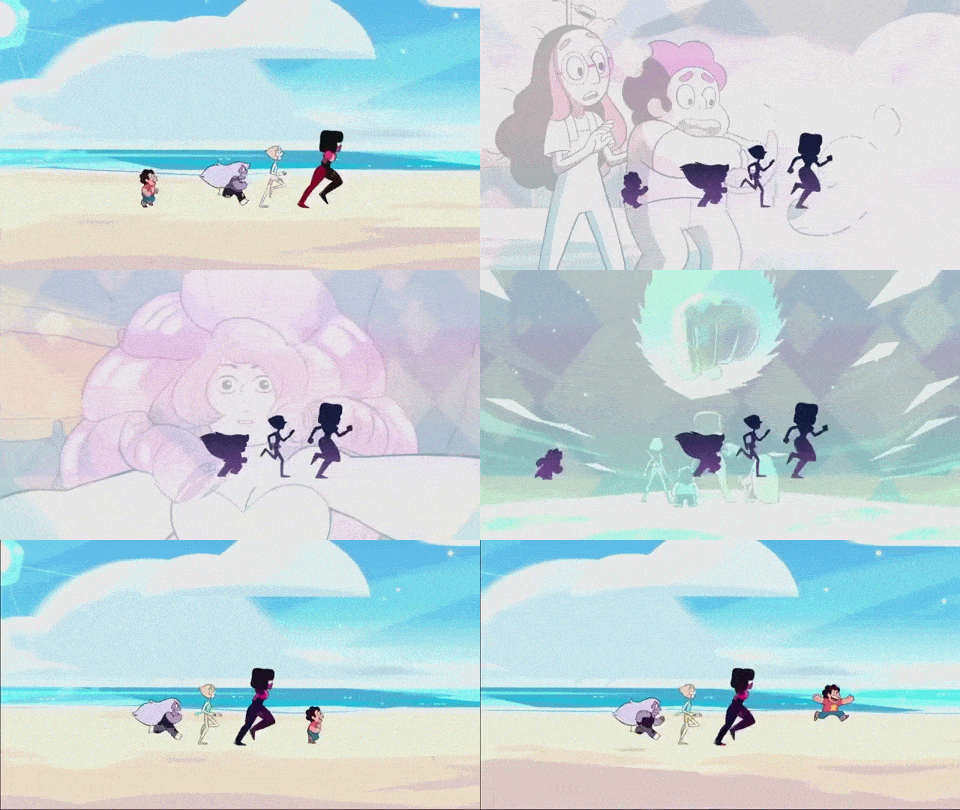
The last true topic shown in Steven Universe is their coverage of mental illness. In a recent episode "Mindful Education", the audience gets to see deeper into the anxiety of Steven and his friend Connie. Connie accidentally hurt a kid at school in the hallway and felt very guilty about it. Steven has also gone through similar, but must worst experiences being a Crystal Gem and having to fight and hurt other gems. Neither one of them wants to talk about/confront their anxieties, therefore they fall apart when they fuse into Stevonnie. Garnet tells them they must think about the bad things in order to move on. They sing a duet called "Here Comes a Thought" in which they calm their nerves together as a fusion. Anxiety can begin at a very young age and can affect someone awfully if they don't deal with it right. Another mental illness hinted at in the show is depression through Lapis. She is real messed up after she is released from Malachite, and has a very pessimistic and sullen attitude. Even before this, she didn't care much for her own safety. But Steven shows her some of the beautiful things on Earth, and she becomes friends with another gem named Peridot who has also had a bad experiences with Jasper. Finding comfort and happiness in the world and in your friends is another true coping method the show introduces to it's audience. These illnesses are often avoided on even adult television, so the fact that Steven Universe chose to cover really justifies how progressive the cartoon is.

Steven Universe is one of the only cartoons that truly captures what it means to live in America. Rebecca Sugar has truly shown how a children's show can still cover real world topics with shoving ideas in their face. I highly recommend this Cartoon Network show, and look forward to how it will continue to cover true topics in the future.

Tuesday, September 6, 2016

The Message Behind Macklemore's ¨Same Love¨


In 2012, rising star Macklemore released a new hit single featuring Ryan Lewis. The title of this song was Same Love. Even though this song was released about four years ago, recent events have connected back to this award winning song. The song Same Love is a different way to bring attention to gay rights and how our country should become more accepting and appreciative of all people and their lives.

The theme of this song is to promote gay rights in America, with lyrics such as,

¨Its human rights for everybody, there is no difference!
Live on and be yourself”

Suggest that America should support gay rights. Macklemore and Ryan Lewis are taking a different approach on trying to take a stance in this country, and in many ways relating to real world issues through clean lyrics and a smooth rhythm. Although the law passed for legalizing gay marriage was not passed for four years after, it still had a great impact in sparking awareness and pushing people to stand up and fight for what they believe in.

The 2012 hit song didn't win the ¨MTV Video Music Award for Best Video with a Social Message¨ just because it was catchy. Macklemore's lyrics do more then just stick with you, they send the message that there is a problem in the US that needs to be addressed. After the legalization of gay marriage across the country on June 26, 2015, a discussion sparks about how much impact this song, and many other social media sources, had to do with this huge decision. When looking deeper into the lyrics of this song, it's clear on the stance that the artists are taking, 

¨We press play, don't press pause, Progress, march on, 
With the veil over our eyes, We turn our back on the cause, 
'Til the day that my uncles can be united by law¨. 

The issue of gay rights was put on the top of the ¨To Do List¨ for America when people started to support this song and continued to support gay rights.

All in all, Same Love by Macklemore is not in fact a hidden message, it is a blunt recognition of a very important issue in our country. The song draws in a crowd that may not have been aware of the gay rights issue and shows them why they might think about joining in movement. In the end, Same Love was a great, creative way of passing a message across the nation.

Sunday, August 30, 2015

Modern Family: Promoting or Defying Stereotypes?

Modern Family was groundbreaking when it first aired in 2009, depicting two of the main characters as gay and in a committed relationship. Since then, it has become one of the most popular shows on television. The show has won numerous awards for its unique and humorous take on the family of today. Modern Family has become more relevant in today’s culture with the recent Supreme Court decision legalizing gay marriage. Mitchell and Cam, the gay couple featured on the show, recently got married on-screen. Although Modern Family promotes some gay stereotypes, the show presents Mitchell and Cam as just another American couple with the same interests and aspirations for a happy family life.

Modern Family, however, does feed off of the stereotype that gay men are feminine and style-conscious. Many of Mitchell and Cam’s friends are other gay couples, many of whom have unusual names, such as Pepper, Longines, and Crispin. Pepper throws theme parties for their gay couple friends, which Mitch and Cam frequently attend. Many of their friends are fashionable, and have great taste, like Mitch and Cam. As a sub context of many story lines, they seem to be always obsessing over the newest art piece or fashion trend.
Following another stereotype, Cam is a flamboyant and extroverted character. His appearance, along with his personality, highlight a common misconception about gay men. Cam wears daring fashion pieces and has an interest in the arts while also taking on the role as a “stay-at-home dad." While Cam is portrayed as the typical gay man, there are layers to his character that defy his stereotype.

Cam grew up on a farm in a conservative family in Missouri. He frequently talks about his life before moving to California, and how he would have to “rough it out” living on his farm. Cam also has a strong interest in sports and is a high school gym teacher and football coach. He also was a football player at the University of Illinois.

Modern Family displays Mitch and Cam as any other American couple, struggling with financial issues while raising a daughter and balancing work and family life. While Modern Family does depict the couple in a light of stereotypes, it also shows them as the new ‘normal’ family of today.

http://www.imdb.com/title/tt1442437/

Thursday, March 12, 2015

Gender Rant

Our discussion in class today was based on comparing two different kinds of identity - gender identity and biological gender identity. However, something struck a chord in me during this discussion. I've come to the conclusion that a biological gender identity doesn't actually exist. Gender is simply an illusion caused by conditioning, a closed-minded concept that will never be fulfilled.
Sex and gender are two completely different things - sex is based on your physical body and gender, now that is something different. Gender is a social construct, almost exactly like race. People in our society look at somebody's physical being and, of course, gather information that helps them come to a conclusion about the person. 
When you look at somebody's body, you see their sex. You don't see their gender. You may see outward expressions of their gender. But this really only leads me to question what gender actually is. Is a man wearing skinny jeans expressing his gender or his sexuality? Or is he just wearing skinny jeans? 
I believe each and every person has both beautiful masculine and feminine qualities within them, and these are nothing to be ashamed of. Feeling like you must be more masculine than you are is simply not accepting yourself and trying to conform to societies hopeless categories. 
Personally, I don't conform to any gender label. I call myself a "guy" for reasons of convenience, but what does that really mean? How am I supposed to know if I feel like a man? 
Is there a potion that I can drink that can show me how a true man feels and then I'll be able to tell if I'm a man? 
Pretty much what I'm left with now is a further affirmation that a given gender doesn't exist. You just are yourself - your ever present personality - and gender is a social construct that we use to try to categorize people and create false expectations. It's really sad the vast majority of people in our society are looking for something that isn't there! It's time to cut out that internal dialogue of "was that manly of me?", "what would a real man do?" out! I promise your heart knows what is best for you. 
So this rant was extremely all over the place but that's okay. I think I mostly got my point across. 

Gender Identity and Public Restrooms: a quick thought

Gender Identity has been a hot issue in the United States for years, although it only truly affects people who were born a different gender than they identify as. Personally I believe that people should be able to cross-dress if they like, etc. although I do not agree that transgender people should be able to use the public bathrooms of the opposite sex. I say this because although it may be exclusionary against transgender people, who are a very small percentage of our population, it gives predators opportunities to find prey. More than likely people who have fetishes of sexual interactions with children, or pedophiles, will take advantage of the legal right to use the restroom of the opposite sex to find children to exploit, who may be unattended by an adult. The legal right to use restrooms of the opposite sex would also result in an increase of "peeping-toms". Although Transgender people may not be very happy about it, I believe it is in the best interest of the general population to keep public restrooms for people of that sex.

Thursday, January 22, 2015

Brooklyn Nine-Nine – Diversity at its Best

Brooklyn Nine-Nine provides a great example of diversity on mainstream television. Racial diversity is acknowledged and accepted, but not the focus of the show. The show follows the fictional 99th Precinct of the NYPD on their day to day crime investigations. Andre Braugher stars as the captain of the Precinct, Captain Holt, a gay black man who has fought for equal opportunities at every point in his life. He completely breaks stereotypes about men of color and of gay people, and is a wonderful captain of the precinct. Holt is an intelligent, brave, and stern leader, and provides a positive influence on his team.

The show also presents another positive image of a successful black man in Seargent Terry Jeffords, played by Terry Crews. He loves to exercise and is forceful, but his character completely dispels the stereotype of a violent black man. He is overly sensitive, married, and has twin daughters, is always worrying if he is being a good father. He creates a unique image, combing tough guy and loving father, and describes himself as the Ebony Falcon, "monogamous and too tired for sex so his only indulgence is fresh fruit yogurt parfaits." While these unique characters allow for hilarious jokes, they also provide positive images of black men, without focusing only on their race.

Brooklyn Nine-Nine also presents two Hispanic women, completely different, but both unique and compelling. The show does not address their race in the same way it does with Jeffords and Holt, but Amy Santiago played by Melissa Fumero, and Rosa Diaz, played by Stephanie Beatriz break out of traditional gender and race stereotypes. Santiago is Cuban-American, and the show presents her as an uptight rule following sycophant. Diaz, on the other hand, is curt and aggressive, and doesn't take nonsense from anyone. Although these portrayals of Hispanic women are extreme to provide comedy, they still present both women as successful and intelligent. The show acknowledges that jokes about race can still perpetrate stereotypes, and so there are rarely jokes about race.

Overall, Brooklyn Nine-Nine might appear to be overplaying it's minority card, as the main character, Jake Peralta, played by Andy Samberg, is half Jewish. All of the main characters expect for one are minority races, which is very rare for a prime time show. However, the characters are natural and relatable, and the show does not focus on the experience of a minority group, but rather a group of friends who work together.  Brooklyn Nine-Nine provides a positive step in racial diversity for television, as it is one of the first popular shows to incorporate race without focusing entirely on race.


All or Nothing Representation (And Why it Doesn't Work)

The United States is a country that idolizes the white man - there is absolutely no debating this subject. Both racism and sexism have existed in our country since before its birth, putting white men (particularly straight, Christian white men) on a pedestal above everyone else. Despite this fact, the United States is also a very diverse nation. Both of these facts, when combined, create a very tricky situation in many aspects of American life. One of the trickiest of these situations is perhaps the problem of equal representation in media.

I will be examining the particular media of film, and two particular examples from the recent cinema: Selma, and The Hobbit franchise. Film is perhaps the media in which racial and sexual representation matter the most, due to its intensely visible nature. When a movie lacks diversity, it's impossible to ignore, because it's huge and glaring on an enormous screen directly in front of the viewer's face.

For a very, very long time, the film industry had virtually no representation for any sort of social or ethnic group that wasn't the white straight Christian male. Straight white Christian women were the only exception to this rule, although not by much - most roles that female characters had to play were sexist, stereotyped, boring, or downright offensive. This wasn't always the case where female characters were concerned (particularly during the period where the Fred-Astaire-Ginger-Rogers type couple dancing movie were popular) but as time progressed, women in film regressed into the state of All or Nothing representation. This is a state that they now share with people of color, sexual and gender minorities, and all religious minorities. 

All or Nothing representation is a spastic pattern of high and low extremes. Either the group in question is not represented at all in the film in question, or the film is entirely about being from that marginalized group.

Two of the examples I've chosen are the Hobbit movies and Selma, two very recent and very different films. The Hobbit is an excellent example of "Nothing" representation. The viewer would be hard pressed to find a single person of color in any of the three movies. I counted maybe two, and both of them were non-speaking parts in the middle of a crowd in the background of a single shot, so I hardly think that counts. In short, every single character in the Hobbit franchise is white. Selma, on the other hand, is a movie with excellent, complex roles for people of color in abundance. However, while Selma may have superior representation in pure numbers, the movie is entirely about the experience of being a black person.

Why is this a problem? By having All or Nothing representation for any marginalized group in our media - especially film - we are teaching people within these groups that the only story that they can be in is one that focuses solely on their role in a marginalized group, and it teaches the more privileged individuals outside of these groups that the people in question (be it women, people of color, sexual/gender minorities, or anything else) aren't a "normal" part of society and are only worth their surface value.

Without a question, "All" representation is far better than "Nothing" representation. In a society where so many people are completely whited out of existence in our media, it's nice to have any sort of representation they can get. However, when was the last time a black protagonist ever did anything in a film besides march on Washington or run away from slavery? When was the last time a woman got to ride in a spaceship and save the world without the hindrance of stereotypical gender roles and obligatory love interests, or having her movie dubbed a "chick flick"? When was the last time a gay protagonist got to fight bad guys and have car chases instead of having an entire two hours devoted to discussing the hardships of their sexual orientation? When was the last time a Muslim, or a transgender person, or a Vietnamese American even got to star in their own movie, much less do something interesting in it? 

"All" representation is still a step up from none at all, but is a far cry away from being anywhere near equal. The people who belong to these marginalized groups are only taught one thing from these types of films: they will never be able to become more than their race/religion/sexual orientation/gender identity/etc. No matter how many interesting stories they have to tell, the only one that's ever worth telling is the one that tells how hard it is to belong to that one marginalized group. When will we finally see a Muslim flying a spaceship, or an intersex individual discovering an ancient tomb and fulfilling an ancient prophecy, or an American Indian making a life changing road trip across a dystopian future wasteland? When will we finally stop defining people by the one trait that doesn't fit our "ideal" model, and instead let them star in the stories we've been letting white men star in for centuries?

Thursday, October 16, 2014

Take Me to Church//Hozier

Recently I have become  huge fan of the song 'Take Me to Church' by Hozier, an Irish singer-songwritter. It's a great song and I would recommend anyone to listen to it. Just as I sat down to dinner to think about what I should post about this week I heard this song come on. As I blindly listen to the lyrics and repeat them, I begin to wonder what they really mean. Curious, I googled the music video and lyrics to come to a better understanding.

I started by just watching the video. If you watch the video yourself you will see that it is all about two men who have a secret in a homophobic society, ending in a hate crime. And of course this message was obvious. But to me what is not so obvious is the message the lyrics send. If I were you, before reading the rest of this blog post, I would watch the music video and listen to the lyrics closely before you come to assumptions and judgements.

I believe that Hozier uses Church and a feminine pronoun to represent anything that the church he grows up around frowns upon. Clearly the music video links the song to homosexuality but it isn't just that. Personally I am not very familiar with any church atmospheres, but I think that he mainly references the Catholicism or Christianity, because there are a lot of ideas they frown upon in society. For example, drugs, sex before marriage, and homosexuality being some of the most popular. I AM NOT MAKING ANY ACCUSATIONS. I know perfectly well that people have their own ideas and can be part of a group or religion and go against what is expected of the church. I understand religion does not define a person.

In the lyrics of the song, Hozier "She's the giggle at a funeral/Knows everybody's disapproval/I should've worshiped her sooner" He is saying that drugs or homosexuality is the giggle, and it is frowned upon and could make every judge you. He also says, that it must be embraced when you are
comfortable. I don't think he is really referring to drugs in this situation, but more likely adultery and being gay. The second lyric I'll share is "I'll worship like a dog at the shrine of your lies/I'll tell you my sins and you can sharpen your knife/Offer me that deathless death/Good God, let me give you my life" He is kind of being sarcastic. Now that he, or who ever is the subject of the song, is accepting sin the religion becomes the sin. But if you are going to accept sin, why have someone judge you when you can keep it to yourself. There's no need for him to anger someone who he knows is homophobic.

I could go on about all of the lyrics in this song and translate it but some of it is better left unsaid and for you to figure out. I really hope you take a listen to the song, not only is the message powerful and thrilling, but it is a great song.

Thanks.

P.S. If you are interested about what the writer of the song has to say about the song himself click here for the interview he did.

Thursday, September 18, 2014

Out of Touch

When I first joined Scouting at seven years old, I had no concept of the ongoing struggle for acceptance members of the LGBT community had to deal with in their day to day lives. I didn’t even really know what being gay was. All I knew is that when I asked some of my friends why they had not joined Scouts with me, all they said was that their parents didn’t agree with the Boy Scouts’ values. I remember thinking how strange that sounded, because it seemed hard to disagree with any of the noble values listed in the Scout Law. A Scout is Trustworthy, Loyal, Helpful, Friendly, Courteous, Kind, Obedient, Cheerful, Thrifty, Brave, Clean and Reverent. Over time, however, I learned that there was a reason Acceptance wasn’t one of the 12 points.

​For years before I had joined Scouts, and for the nearly ten years I have been a member, the BSA has had the discriminatory policy of not allowing gay Scouts or Troop Leaders in their program. Most people tend to know of this policy from when it was taken to the Supreme Court in the 2000 case, Dale v. Boy Scouts of America, in which a gay leader was forced out of the program for their sexual orientation. The BSA received extremely negative press, but ultimately the court ruled that as a private organization they could associate (or disassociate) themselves with whoever they pleased. The organization has continued this policy for more than a decade, often drawing national attention for banning gay scouts and leaders. LGBT organizations and other objectors have called the BSA out of touch with public opinion. This validity of this critique is apparent, considering that all the other major American youth clubs, including 4-H, Girl Scouts, and the Boys and Girls Clubs of America have all accepted LGBT members and leaders. In the most recent presidential election, the nominees of both parties, who can normally agree on nothing, condemned the Boy Scouts’ policy of discrimination.

​Personally, I cannot say I’ve had many encounters with discrimination in Scouting. Being a member of a very liberal troop in a very liberal town, I can’t imagine any boy being barred from participation for any reason. Unfortunately, I and other members of my troop have had to deal with the negative connotation that the conservatives at the head of the organization have embraced: Scouts think being gay is inconsistent with the values of the Scout Law and the Scout Oath, one of the key points of which is being “morally straight.”I am deeply saddened that most people look at the Scouts andsee only this discrimination. However, I am even more saddened that those people who have been discriminated against will never have the chance to know the more positive aspects of scouting- values that I believe are in no way inconsistent with who they are.

​As I am nearing the age when I can no longer be considered a Boy Scout, I must reflect on the meaning of my participation and the program itself. Some of the best experiences of my life have happened while wearing a Boy Scout uniform. At the same time, the policies of the BSA executives have brought shame to the uniform and all who wear it. I am working towards the highest rank of the Boy Scouts, Eagle, but it is near impossible for me to say that I embody the values that supposedly conflict with the core identity of other human beings.

Op-Ed Persuit of Happiness


Religious traditions can have a positive outlook on one’s life. For example, in the Catholic 
Church one of the “coming of age” events is Confirmation, where young people are finally 
recognized as adults in the church community. But not all traditions are positive. For example,  religious zealots refuse to recognize the acceptance of gay marriage by the state. They use tradition as an argument against gay marriage. I feel this tradition should not be followed. It is very unfair to discriminate against the entire LGBT community by denying them their right to marry. Marriage could be the gateway to happiness for many future couples. 

Many countries such as the Netherlands, Canada, Spain, England, and Belgium have already accepted same sex marriage as well as 19 out of 50 states in the U.S. have accepted it too. Have there been any negative results from these marriages? Everyone should have the opportunity to marry. A legal contract that is available for one pair of people should be available for another pair of people.

I want to look at the essential unfairness of allowing only heterosexuals to marry. It is not fair that heterosexuality is prefered or is considered to be "normal”. The reality of someone being treated differently is wrong.

I am a child who is growing up with a same sex couple as parents and everything to me seems to be completely normal compared with heterosexual couples. Ever since I was a little kid my parents always hid the official title of “lesbian” or “gay” from me because they thought that I would be ashamed or embarrassed of them. I was extremely confused at the time. My mothers would always say that they were just really good friends or partners. That’s why I thought it was normal to have two mothers instead of having the traditional mother and father. Eventually, I was old enough to look at my life and realize that they were gay. I didn’t even mind. I also noticed another strange thing; I have never seen either of my mothers show any signs of affection besides hugging, or kissing each other on the cheek.

When I first found out that gay marriage was legal in Illinois I asked them if they would ever get married. They simply said, “Why should we get married? We’ve been together for so long. How would getting married change anything?” Even though my parents don't want to get married if they wanted to go forward and get married I think they should have that they should have that opportunity. Luckily Illinois passed a law allowing same sex marriage last year.

In the United States people are supposed treated equally under the law. The Constitution states, “ We hold these truths to be sacred and undeniable; that men are created equal and independent, that from the equal creation they derive rights inherent and inalienable, among which are the preservation of life, liberty, and the pursuit of happiness.” The law is supposed to eliminate bias. For many people marriage is part of their pursuit of happiness. They should not be denied this opportunity because of their sexual orientation.


Monday, September 1, 2014

Different Shades of Gay


The way that gay men are portrayed through media, specifically television, is not only often an offensive exaggeration but also supports the American ideology that most gay men act like women. In past history, gay characters were both negatively and infrequently portrayed on television. When gay men and lesbians were represented on TV, they typically appeared as mentally unstable, or morally corrupt individuals. However, in recent years, new groundbreaking shows started to appear. In the mid-90s, a popular sitcom, Will and Grace, introduced a character who went against these common stereotypes.

Will Truman, is a different representation of a gay man than what audiences were used to. Will is a successful lawyer and a very logical thinker which began to break down those previous assumptions of the Gay community as reckless, unstable, and unable to live a moderate and professional life. Will also lives a life of routine, with little partying, and nearly no pizazz which supports the reality that gay people live an array of different lives and are not confined to one image of “gayness”.

Jack, another gay male on Will and Grace, is in many ways a perfect reflection of the stereotype of the flamboyant, fashion crazed, promiscuous gay male. I think that what makes this show revolutionary is that it shows both characters side by side, breaking down the idea that gay means one thing. Here we have one character breaking down the barriers of a stereotype and one character supporting it which reveals that both can exist together. Recently through media Americans have been given an even larger taste of what being gay can look like. Audiences can see that there is not just gay men like Jack or Will, there are many other personalities in between. Shows like Modern Family and The L Word and artists like Macklemore and Rob Halford of Judas Priest to name a small few have opened America up to the reality that being gay does not mean one fixed thing. The spectrum of what it means to be gay, straight, and everything in between is not fixed and popular culture in America is finally beginning to reflect that.

Friday, August 29, 2014

"Modern Family" Values

The ABC show “Modern Family” is a primarily truthful reflection of everyday family life in America. The show follows one large extended family made up of three interrelated nuclear families. Although the show succumbs some personality stereotypes, it truthfully represents many aspects of American family life through its characters and the relationships between these characters.

A few characters on “Modern Family” are cliched and feel less truthful. Claire, the mother in one of families, is portrayed as just that- a mother, with no apparent life outside of her family. She is also shown as a catty, malicious woman, jealous of the beauty of her father’s new wife and constantly absorbed in revenge plots against everyone around her, including her children. This harmful stereotype brings down women by implying that they are inherently jealous and vengeful.

The other character who is quite cliched is Jay, the father of Claire and patriarch of the family. He is portrayed as a classic older, white, wealthy man- he spends most of his time at the country club playing golf, advocates for old-school manners, and dislikes his son-in-law. However, Jay’s relationship with his adopted son Manny shows him in a different light, making him a more unique and thus more truthful character by showing him within a realistic relationship.

Although Jay and Claire are somewhat unrealistic, stereotyped characters, other aspects of “Modern Family” are more true. For example, one of the families featured on the show is made up of gay partners, Cam and Mitchell, and their adopted daughter Lily. Their family presents an alternative the American ideology of a “cookie cutter” suburban family made up of a mom, a dad, and 2 or 3 children.

Another true element of modern family are the characters Haley and Alex, the two daughters of Claire. At first glance, these teen aged girls seem to fit into the false ideologies of American society- Alex is the geeky smart girl, while Haley is the dumb-but-pretty popular girl. However, their characters are rounded out and revealed to be far more nuanced as the show goes on. Haley is shown to be much smarter than she initially appears, albeit in a street-smart rather than book-smart way. She also reveals ambition, shrewdness, and kindness as her story progresses, all traits that do not fit into her stereotype. Meanwhile, Alex is shown to have a large group of friends who share her interests, a much-needed challenge to the ideology that “nerds” have no friends at all.

What is most truthful about Haley and Alex, though, is their relationship as sisters. Like real sisters, they alternately love and hate each other, best friends one moment and worst enemies the next. But their relationship does not only exist at extremes, and sometimes, they’re just normal sisters living together and facing everyday challenges, doing homework and worrying about applying to college. The truth of their relationship and their lives allows viewers to relate, making the show as a whole more successful.

All About That Bass; Breaking the Barrier Between Feminism and Facade

All About That Bass by Meghan Trainor is a so called "body positive song" that focuses on the singer not being overly skinny yet still being confident in herself and her body. This song has had a lot of controversy surrounding it, because some people think that it is skinny shaming, and/or gives in to bad stereotypes about women and men, while still others think it is just a good body positive song with a strong message. This song could have arguable points either way, and it breaks many stereotypes about “fat” people and how they’re ugly or undesirable because they aren't stick thin. It also brings relatable points to young girls about positive body image ideas. By the same token, it puts down skinny girls, and Trainor justifies her body image beauty by bringing men into the picture, which makes the song feel less and less positive the more you think about it.

This song centers around the singer, Meghan Trainor, talking about how she “ain’t no size two” but that she is still beautiful, despite not being skinny. She also leaves a message not only about herself being beautiful, but anyone who doesn't consider themselves “pretty” with the line “every inch of you is perfect from the bottom to the top” This breaks down many American stereotypes surrounding women, the biggest of course being that if you aren't "skinny" you aren't beautiful. This is a great message to send, especially when a huge portion of the media is dedicated to putting down women. 

 Women aren't supposed to feel good in their own body. When you hear a woman say that she likes the way she looks, people tend to think of her as vain or self centered. Makeup is a social norm, and all over America there are commercials, billboards, etc, portraying skinny, photo-shopped, unrealistic looking women selling products of all shapes and sizes, though the woman is always the same. Overly skinny, creepily symmetrical face, tall, silky hair, essentially a barbie in human form (this is of course not talking about women who are naturally skinny, but the overly photo-shopped carbon copy images of women displayed commercially, and practically everywhere). Meghan Trainor mentions this, saying “we know that sh*t ain’t real, c'mon now make it stop.” She is breaking down stereotypes about women and giving them a nicer view of their own bodies, which is good right? Sadly, the rest of the song isn't so kind.

Despite these positive factors, she also is skinny shaming, with the line “I'm bringin' booty back. Go ‘head and tell them skinny b*tches that”, which has caused an uproar in the YouTube comments, saying that it isn't body positive if you are putting one body type down to bring another up. I completely agree, and I have seen countless people in comments with the mindset that skinny shaming doesn't exist or isn't important. This is hugely untrue, and some of the harsh things "skinny" girls hear can be hugely damaging to self esteem and confidence. It can even lead to serious eating disorders. You may say that a song alone couldn't do that, and you'd be right. But add that to hateful comments during the school day, snide remarks about food from your peers, and you get a very sad skinny girl feeling guilty, or uncomfortable in her own skin. 

Trainor also mentions in her chorus “now my mamma she told me don’t worry about your size, she said boys need a little more booty to hold at night”. By bringing the want to have men desire you into the song, makes it appear less body positive, and brings back stereotypes that women are only there to please men. They are beautiful no matter what, as long as a man wants them. This means for a woman to be confident in her body, she first must have a man's approval, which is another extremely harmful idea. 

This same stereotype can be harmful not only for women and men, but also for the LGBTQA community. This ideology leaves out gay/trans/bisexual/etc women and men entirely. It is hetero normality, which, in my opinion, can be just as harmful as the skinny shaming. LGBTQA youth are hugely underrepresented in television, movies, books, music, and other forms of pop culture. It is a rare thing to see an accurate portrayal of them in today's media, and when it does happen, the backlash the show or movie or song receives is overwhelming. It can be extremely difficult for a young LGBTQA teen to come out, or even to just accept who they are, and the media does a horrible job of making it easier. This song is no different. By pushing straight couples on screen, they are inadvertently repressing these other sexualities/genders/etc. This is of course, not saying there shouldn't be straight couples and people in the media. What it is saying, is that this shouldn't be forced onto people, or assumed, as it often is. 

Even though the song may only be certain lines or phrases portraying these kind of views and ideas, it takes away from the whole picture of body positive images. Overall, though Meghan Trainor’s song may have many strong points about body image, it should really be taken with a grain of salt, if taken in at all. Body image should be about loving yourself, that's it that's all. It shouldn't be about other people's bodies being above or below your own, it especially shouldn't be about pleasing other people, it should be about YOU. 

 After all: