Showing posts with label Postmodernism. Show all posts

Sunday, December 18, 2016

Creating a Fake Identity in a Post Modern World

You can find anyone through social media these days, and how could that be a bad thing? Social media has given us ways to connect with so many people in a variety of different ways. People can spew out their opinions on anything through Twitter, share a picture for a short time on Snapchat, put basically anything on Facebook, upload picture to Instagram and videos to YouTube. 

And yeah, staying connected is great. But social media only shows the highlights of people's lives. We see images of friends, friends of friends, the people that you never talk to but you always pass in the hallways, celebrities promoting brands and their own images, and companies promoting themselves. Which is okay, but eventually people think that the highlights is that person's everyday life. 


But, as a social species we need validation, so we try to compete with every single image that comes our way. Some people don't feel this need, they're perfectly fine with who they are. Others post anything wanting to get the most comments, the most likes, the most views, or even the most shares. They only share their best to their own friends and followers and the cycle just continues on.

People  begin to make themselves up to be greater than they actually are. Can we truthfully even know someone through social media? Because while people are not exactly lying, we are not showing our daily life either. 


Tuesday, December 13, 2016

Living in our Man Made World


In this day in age it is hard to go anywhere without seeing electronics, advertisements, music or magazines with way to skinny girls on them. In seeing this it is hard for you not to ask how much do these things control our lives and influence what we do. In this time we are still living in a postmodern world.

In America self image has become less about who you are and more about how you look. Instead of self image being about what you want to be it has been mutilated into a lifestyle of what everyone else wants you to be. And, because of this America and it’s youth are hurting themselves just fit into a stereotype that they can never be. As a women in America from a young age you are taught what to be. Growing up all you see is women in magazines and t.v shows skinny as sticks telling you to be just like them, and that they got there beauty naturally. But what society doesn't tell you is that these women either work out 24/7 or bodies are cropped into perfection onto a computer. In our postmodern world we use these false images to guide how much we eat and how we should exercise.

We also use celebrities as a guide on how to spend our lives. Through a variety of advertisements. In commercials we see the singers and actors advertising things like clothes and beauty products. So, we spend a lot of our money on things that are over priced making actors and companies rich while we try to feed into the man made stereotypes of coolness. another way that media controls us is by music. famous singers flaunt their money, girls and cars in front of our faces telling us this is what we are suppose to be. we are suppose to act a certain way to get to this fictional promised land where we get everything we dream of.

And as naive easily influenced human being we try to reach for it posting our lives on social media as evidence that we are getting further in our lives than everyone else. we grasp at straw, like and follows to prove that we are as popular and making our way to somewhere we never get to.


Thursday, December 8, 2016

Post Modernism in Today's Culture


We live in a post modern society. This is largely because of technology and social media. Today, it is so easy to lie or make something up on social media, that you can never really tell what the "truth" is. Post modernism explores this idea that people's perception of what the truth is can be so easily altered. A very good example of this is Magritte's "This Is Not a Pipe." 


Image result for magritte this is not a pipe


This piece makes you reconsider what the truth is. Is the object that we associate with the word pipe really a pipe? This piece seems so simple at first glance, but when you stop to really think about it, it poses a very existential question. I think this is essentially what post modernism is.

Monday, November 28, 2016

Postmodernism in American Culture

Postmodernism is prominent in American culture in 2016.  Technology has given people easy access to different cultures from celebrities to everyday people. Nowadays, people are able to show their experiences and culture all over social media, which gives everyone a chance to see more than their own perspective. Social media lets people express their ideas of what makes something "art," and it allows people to admire others works of art. 

There is no longer one standard of what makes something better or worse because it is all based on opinion. Although there can be ads showing the "best" things to wear or do, people are always trying to achieve something even better or different. Specifically, celebrities and artists are known to break away from what is usually done, making their own idea of art. Before, there were standards and everyone followed the rules and what was to be expected of them. In our culture, it is important to be an individual and have unique opinions and actions. The control that people have over their lives is what shows how much of a postmodern world we live in.

Tuesday, November 22, 2016

Postmodernism in 2016

We are in an age of postmodernism. Our culture is constantly being redefined by the common people and celebrities alike. Technology and the expansion of the internet has fertilized the growth of postmodernism in our society. Any person has readily available exposure to cultures and people who live different lives than them. Seeing different people and understanding how their lives are different than yours lets you see things in your own life from different perspectives. This aspect of postmodernism in our society lets people think about what makes art and how to see things from multiple perspectives.

In this day and age everyone wants their own image. Celebrities attempt to distinguish themselves as individuals, be that by having the most outrageous outfits, the most bizarre hair, or the strangest outfits. 

People in our society who represent themselves differently than others make people think about what they consider to be fashion or style. They have to define art for their own life. The beauty of postmodernism in our society is that every one can have their own ideas of what art is what art is in their culture.

The presence of postmodernism in our society broadens the experience end cultural exposure each person has. People are more unique and stand apart from each other in postmodern societies. Every person creates their own interpretations of the world around them.

The Post in Postmodern


Post- a Latin prefix, meaning "behind" or "after." Therefore the definition of postmodernism should be a time after the modern age. But this sparks the question, when was this world modern? Do different regions of our globe experience a modern age while others are ahead or behind? Once postmodernism is supposedly reached, what more is there? This is why it's so difficult to grasp the concepts displayed in postmodern works, they redefine reality and one's personal truths. It's hard to see how can something be 'after modern' when it's unclear what was modern in the first place. These questions without answers seems to be the purpose of postmodern work. Making the viewer think of a deeper meaning that may or may not even exist. This 'post' in postmodernism could be interpreted as the aftermath of looking at postmodern art or stories. Either way, the complex questions and contradicting answers perfectly summarize the true affects of postmodernism without a defined modernism.

Postmodernism in a Modern World

As our society inevitably becomes more developed, we see schools of thought, especially newer ones, become more applicable and relevant than ever before. Specifically, the ideas that the postmodern movement supplied us with in the late 20th century are nearly impossible to avoid today.

The postmodernist movement is not restricted to the confines of art, although it may seem like that when the credibility and the subjectivity of the idea of art is questioned. Nor is it only confined to literature and thought. Postmodernism manages to encompass all aspects of life, only becoming more relevant now, especially with the limitless ability of the media, especially social media.

While we are expanding the reign of postmodernism in our lives by simply just becoming a more socially and commercially focused society, we are also subconsciously being affected by it regardless of whether accept that notion. Postmodernism isn't just art anymore, it's an amalgam of  paradoxes, spirituality, accepting what we deny, and realizations of ourselves and of the world that are borderline epiphinac.

Mainstream social media is an great influence on the masses today because of how it allows us to filter and negotiate all points of one's life. Because life is not abstract and simplistic, (as post-modernistic art so often is,) social media allows us to break lives down into a series of moments that become still frames and snapshots of our lives that everyone can see. But is that our life? That is what a postmodern way of thinking helps us detect.

In our 21st century lives, filled with awesome technology and unprecedented social freedoms, we still have this urge to create our "ideal life" and to be the "real us." What this actually means is unclear; what determines something being better than something, or more ideal?

Postmodernism only becomes more apt when we, either as a society or as individuals, try to deny its impact on every aspect of our lives today. No doubt, that studying postmodern way of thought and influence on society leaves us with more questions than answers, but isn't that the point?


Glasses Help You See More Than You Think

What is art? When someone says “art museum” what is the first thing you think of? A wall of oil paintings? A room filled with high standing marble statues and stained glass? If you asked this question to one hundred people, odds are you’d get a lot of the same answers. One thing’s for sure, at least. I doubt anyone would respond with “one pair of glasses just sitting there on a hardwood floor.”

That is because this is a piece of postmodern art: defined as a body of art movements that sought to contradict some aspects of modernism or some aspects that emerged or developed in its aftermath, postmodern art has a goal, and that goal is to get you to think. Many might reject a pair of glasses on the floor as a work of art, but it is precisely the objective of postmodern art to get the consumer to challenge what they think they know. Much of this can be accomplished through strange works of art.

One thing’s for sure, and that is that a work of art like this will leave you asking questions. Questions that were triggered using one piece of art, but that could eventually encompass more and more works of art until you find yourself questioning the very definition of art itself.

Postmodernism is changing the way we view the world one pair of glasses, blank canvas, or piece of balled up paper at a time.

Monday, November 21, 2016

Postmodern Lens on Marisol's Last Supper


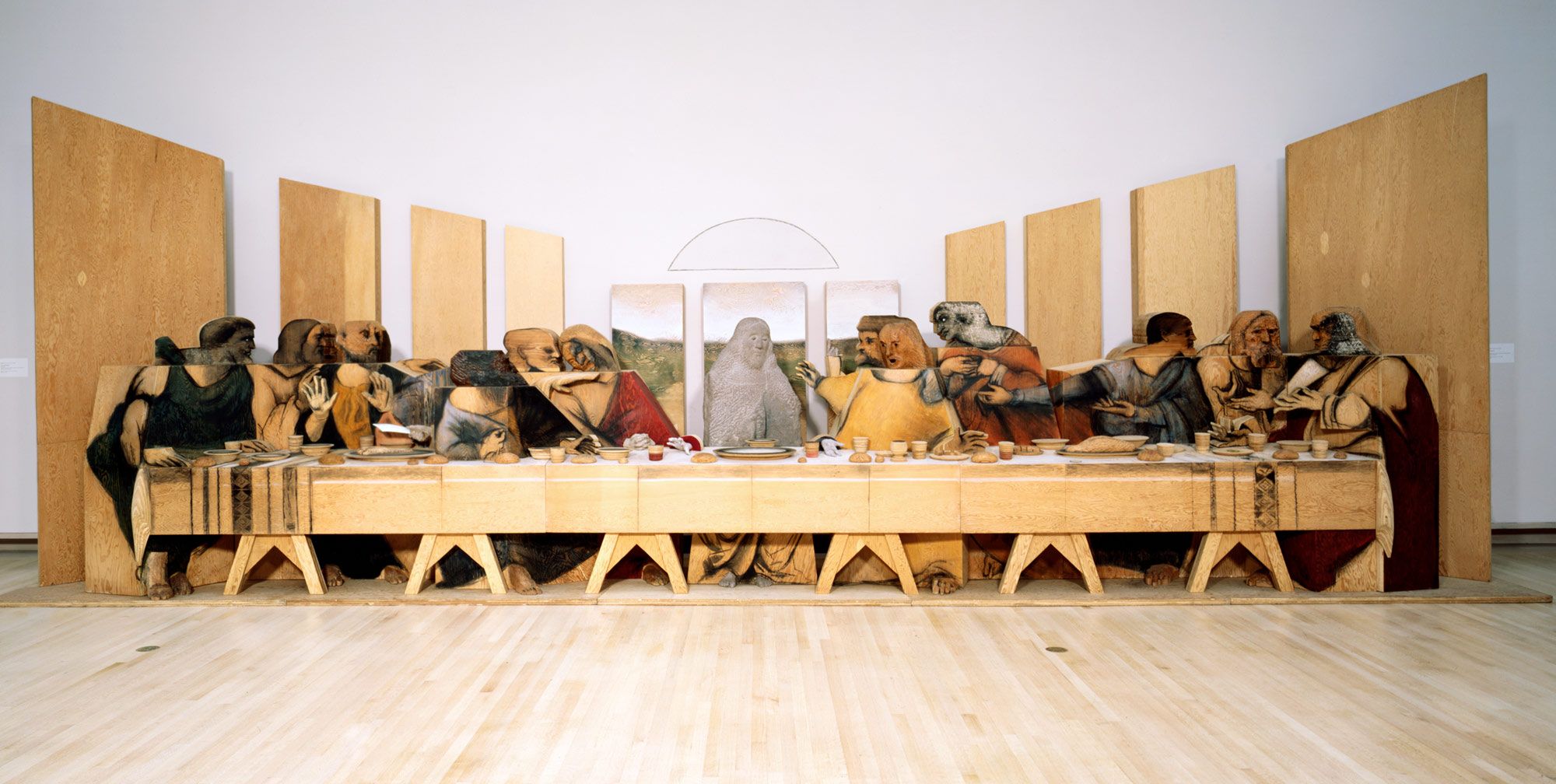
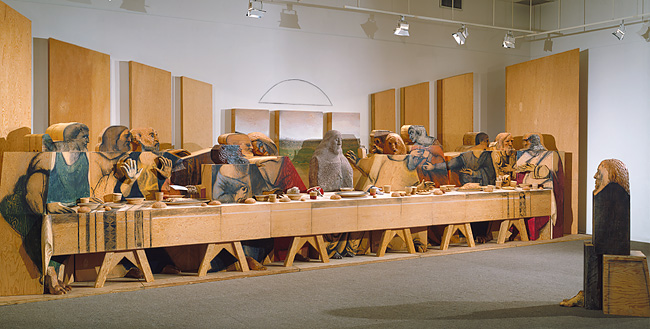
Marisol Escobar, otherwise known as simply Marisol, was an artist of the early pop-art era whose work truly reflects postmodern principles on many different levels. The piece shown above is one of her more famous works, Self Portrait looking at the Last Supper. This work is a take on Leonardo da Vinci's classic painting of Jesus' Last Supper. The concept of the piece itself is very postmodern, but the medium in which the art is created as well as the commentary and discussion it sparks align Marisol's work with postmodern ideals on many levels. 

Though not shown in the first image, the second very clearly shows a figure of Marisol observing the last supper, detached from the other figures but still an integral part of the artwork. Marisol turns the idea of a self-portrait on its head. The focus is no longer herself but her relationship to other figures and to art. The self-portrait is about Marisol's opinion and thought even though those concepts aren't visible in the work. 

This remodeled idea of a self-portrait is postmodern. It questions what a self-portrait is and what is important. Is the self important, or is the way that the self interacts with the world. If a person thinks this "doesn't qualify" as a self portrait, why is that so? What is the significance of observing Marisol's observation? The fact that she references a previous piece of art forces the viewer to wonder what impact art has on their identity. All of these questions fall into the postmodern umbrella of meta-analysis of creative works.

The art is created from wood sculpture, with the exception of Jesus who sits at the center of the table, stable stoic and carved from stone. The bodies of the apostles are made from plywood sheets, continuous and connected, while their heads sit detached on top. The heads aren't aligned with the bodies. Some of the heads are intricately carved, while others are outlined and covered with paint, just like the bodies. 

In her choice of material and presentation, Marisol again deploys postmodern ideals. She forces the viewer to question what they consider to be "finished" or "attractive" art. She purposefully represents the human body in a misshapen and uneven form to pose the question of what humanity is, how it is viewed, and how it should be represented. Making Jesus out of stone also raises many questions about religion and belief systems. Are they worth anything? What do they mean? If Jesus is supposed to be compassionate, why is he made out of the most unfeeling material? It forces you to reconsider both the importance of religious figures as well as symbolism that society has pre-identified for art. (eg. why does stone automatically equal cold and insensitive?)

Marisol herself lived a postmodern lifestyle. She dropped her last name, Escobar, as a way to escape the patriarchal identity that society forced upon her, to make herself visible in a new and truer light. She was a postmodernist, and certainly a postmodern artist. Her creative use of materials and the way they fit together as well as her redefined concept of a self-portrait build off the postmodern ideas of how image, media, and the past create our identities and our perceptions. Self Portrait Looking at the the Last Supper is just one example of Marisol's truly postmodern perspective on art and life as a whole. 

This is Not a Blog Post

I think postmodernism is an interesting way to go about art. It can be a very deep, thought provoking, expressive, and even beautiful art form, that is if you aren't me. I can appreciate the amount of work it takes to come up with something and express it in a piece of artwork, but I feel that i'm not good enough at analyzing art to truly appreciate it. Too much of the meaning flies over my head, but that itself if one of the beauties of postmodern art. You don't need to comprehend what the artist was saying, or even understand it at all for that matter. The fact that most of the pieces can tell something at all, whilst also managing to look good is the true strength of the art form.

Well, because most of the intricate meanings of postmodern art elude me, I went searching for something with a meaning I could understand, while also being simpler than most of the other postmodern works I have seen. I came across this sculpture by two guys, Dan Single and George Gorrow, from Sydney Australia made. Dan was a graffiti artist and George was a poet; the two teamed up and formed a fashion company named Ksubi. The sculpture was documented in a book they made called "Sign of the Times," which is what I will be referring to the sculpture as from now on. Here it is: 


This sculpture is of a man's hand holding up a peace sign, or at least attempting to. Much to the hand's dismay his middle and pointer have been cut off. This has quite the profound meaning. The hand is either trying to offer peace and it has been rejected by someone else, or whoever is offering the peace isn't really looking for peace. I'd guess the latter, due to the face that the man's hand is coming out of some kind of suit and undershirt, eluding to some kind of importance or high class. I believe that this sculpture is about corporate deception, or something even higher like government deception.

Overall postmodern art is kind of confusing and enigmatic to me, but the best part of it is how even if the intended meaning is greater than me, I can still try to appreciate it.

Art?


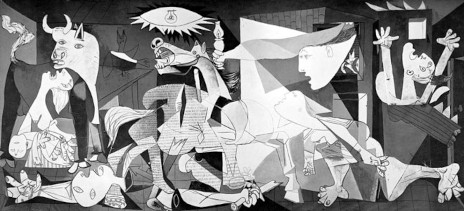
What is art? If you check the dictionary (which is an inane way to define something so subjective) you'd find a definition along the lines of "something beautiful or visually appealing" but that definition should frankly just be tossed out immediately. Ignoring the postmodern movement, there are pieces of art, that are universally regarded as art, that are not beautiful. This is maybe an unpopular opinion but let's take La Guernica by Picasso as an example.
 This is an ugly painting, at least it is to me. Picasso never intended for it to be beautiful, it's meant to capture the pain the people of Guernica felt after a series of bombings during World War II. The figures are distorted and the agony is unmistakable, if you were to find beauty in this painting, twisted beauty is about as far as you could go. But it doesn't have to be beautiful because it has meaning. I'm tempted to say that art derives meaning from the viewer, but just because some 12 year old might look at this painting and get nothing out of it, it's not disqualified as art. So then maybe it derives meaning from the artist.


Image result for invisible art warhol

This is "Invisible Sculpture" by Andy Warhol. The piece in question is not the white box, but what's resting on top of it: nothing. I remember getting into an discussion with a friend of mine after stumbling upon an article saying a similar piece, a blank white, floor to ceiling canvas, had been sold for quite a bit of money. The piece was also titled "invisible" and at the time I thought it was completely idiotic somebody would pay good money for a solid white stretched canvas. It was soon pointed out to me that I was maybe thinking about it too simplistically. When my friend saw the painting, or lack thereof, he was reminded of a child's imaginary friend. Invisible to the surrounding world, but the child could see them clearly. Maybe that's all art is. It derives meaning from those who can appreciate it and see its value. Whether or not everybody can see its value is irrelevant.
I in no way pretend to be an authority on what is or is not art but this definition works for me. I'll admit, it feels like a pretentious answer, but honestly isn't "what is art?" kind of a pretentious question?


Living in postmodern America impacts how we've have grown up. It impacts how we see ourself and others, it impacts things so complex as the uncontrollable thoughts that cross our mind. We don't realize it, but everything around us, the people, the internet, the media, it effects everything we call our own. 

Do we truly like a certain article of clothing? Or is it just that a person we think is pretty wore it and now we unconsciously like it. But what makes that girl pretty in the first place? Ever sense we were born we've been fed descriptions and images of what a girl or guy is suppose to look like. So is what we think is truly our own opinion, truly ours? Because if ever sense we were born we've never been given a real chance to just look at something, with no background knowledge at all, and just say how we feel about it, or what it makes us think of. 

All of our thoughts, judgments, and opinions our based off of someone else's, whether it's disagreeing with someone or agreeing, it's never truly our own. I don't think that we ever will truly get to have a completely genuine experience, of our very own unbiased opinion on anything because the world we live in will always have something to say about it before we do. 

So once you except the fact that your opinions aren't truly your own, you must try to swallow the fact that truth itself is a relative term. If all of our thoughts aren't our own, then who truly decides what is true and what isn't. 

All in all, the postmodern society we live in, forces us to be okay with ultimate uncertainty, as there is no way to ever truly know what are solely our own ideas. Every single little thing we see or hear impacts how we see the world whether we realize it or not. 

You're Not Perfect in The Eyes of The World

Postmodernism is the theories of how people see art differently. In our lives today we are surrounded by this, that we are subconsciously affected by it. Everywhere you go, everywhere you look, there is some form of postmodernism. In these ads, and pictures is where we “find” ourselves, and determine who we are, and how we should look.

One example of this can be seen in TV ads. An ad for a certain medicine to cure psoriasis depicts happy, energetic adults who have been cured of this ailment. In the ad, as these people are doing youthful things, the words “Let the real you shine through!” are played in the background. These words make those who suffer from the disease feel as if they are not them self with coping with the disease, and therefore demote them. In actuality, we should applaud these people for having to cope with this issue.

Another example of this can be seen through social media. In today's world, you can open an app, and instantly find pictures of models. With these pictures you begin to judge yourself, and it makes you want to change in order to be more like these pictures. Instead of focusing on one's individuality, one focuses on how to be more like everyone else.

Is It Art?


What is art? What qualifies as art? These questions are inspired by a new postmodernist perspective. Postmodern art is art that critiques art. Many people have difficulty accepting that some postmodern masterpieces are in fact art. Take for example, a blank white canvas or a, seemly irrelevant, crumpled paper ball. Many people today would reject either as any form of art, postmodern art challenges this.


Although postmodern art can be made for different reasons, it is mainly created to challenge simple understandings of the world. It is created to challenge the viewer's previous perspectives on various subjects. In some cases postmodern art forces the audience to question their perspectives on art itself. The artist sometimes intends to leave the viewer with questions that extend from one piece of artwork to the entire definition of art. A blank canvas or crumpled ball of paper will surely encourage the audience to question whether it can be considered art or not and this is exactly what the artist intended. These postmodern works propose that art does not have to be extraordinary, beautiful and expensive to be considered art but rather that with the correct perspective, everyday objects can be art. Postmodernism is changing the world's perspective on art.

The Reality in Commercials


Postmodernism battles with the image of truth, reality and how to perceive different things in society. This MAC cosmetic commercial represents postmodernism in two ways. The first way it represents postmodernism is because of the fact that it is portraying how we should look. This commercial is selling a product that will enhance our visual appearance and make us look more appealing. In society today, looks are very important. You need to look a certain way or you are not “normal” and do not fit in. By telling us to buy this lipstick to enhance our lips and face, this is feeding into the idea that the image we see in media is reality. So many opinions and views are put into the media in the postmodern era, and they should not define our reality. This artificial image from the media of what we should look like has become so important in our lives and tells us the new reality of what is normal and fake.

The second way this commercial represents postmodernism is the visual aspect of it. This commercial is full of abstract and different visuals that are not common or normal to see in a commercial or art. This commercial’s use of color, movement and shapes expresses an idea that is a contradiction to the “normal’ art we have seen. This abstract form of art breaks the classic art mold that was formed many years ago.

Postmodernism is portrayed in many types of media and influences our everyday lives. It ultimately has a great impact on who we are. Because there are so many "truths" or opinions are being thrown at us, we need to filter them out and make up the definition of who we actually are. Being aware of all of the images that are thrown at us is important in finding ourselves today.

Memes in a Postmodern World

There is no single way to define postmodernism, but it is safe to say that almost everything I read, see, consume, or create is done in  a postmodernist fashion. Ideas about culture and the ways it is conveyed in media are the basis for today's American society. Whether addressing race, politics, religion, or just about any topic that has somewhat relevance there is always some sort of comedic joke or ironic twist on the internet. What is especially interesting is the way internet “memes” have taken over social media and created widespread phenomenon. Internet memes are truly an example of how our postmodern world addresses serious and some not so serious topics.

Memes can be many different things; gifs, text posts, images, and are all frantically widespread throughout all platforms on social media. Memes have a way of taking very serious, edgy, and provocative topics and making light jokes out of them, relatable to all. For example the news and reality of the new President elect has hit America hard, and created controversy and tension all throughout society. In response, a popular strand of Joe Biden memes have take over the internet. These Biden memes all have a common running joke about how Biden is going to sabotage Trump before leaving office. The joke of this meme is that Biden is sabotaging in a childlike and cute manner. Whether Biden is planning on hitting Trump with a football, loosening the screws in the presidential chair, or how he is going to change the wifi password to “I love Mexicans”, the memes reflect the way Americans are dealing with the turmoil and confusion of the new changes that are going to take over political life.
Image result for biden obama memeImage result for biden meme

Comedy and jokes in society have become more cruel, scrutinizing, and harshly honest. Arguably, this boldness in joking is just another reflection on how our postmodern society is completely different than ever before. Jokes and comedy are another way people mask themselves in a society that looks down upon outward emotion and expressing feelings. Adolescents, especially males, are conditioned in society to not express emotion and simply to deal with problems themselves. Joking is a mechanism for dealing with society’s new ideals. It is easy to laugh at a meme about race, politics, religion, etc.. rather than to actually think and deal with the actual topics personally

These dramatic changes in comedy and satire are a reflection on how our postmodern society operate and thrives. Provocative and outrageous internet posts not only help people in a postmodern society cope with change and immense problems, but they also offer an escape from the harshness and realness of real life. Memes also reflect the way people have become desensitized to topics and learned to laugh at topics that perhaps should not be joked around about. Next time that you see a funny internet post or meme, take minute to examine why you think it is so funny. Is it the silliness of it? Or is it the intense and real honesty that it conveys?


Postmodernism In Media

Postmodernism is the general ideologies and theories of how people view different types of art forms. We view postmodern material constantly in our daily lives without even realizing it. Everywhere you look you will find some type of art form that you are unconsciously forming an opinion on or trying to find the meaning behind. Especially in today's media.

For example when you are scrolling through any type of social media you are seeing millions of images of how life is supposed to be, what you should look like, how to dress, and what you need to do to have a good time. As we look through images like this we are shoving all of these pictures in our head and then later comparing reality to what we see in media. The distinction between reality and media has become extremely blurred.

Postmodernism has allowed us to take all of these things we see in media and help us to form our own opinions on what we like and what we don't like. It allows us to choose what TV shows we watch, what kind of music we listen to, and just how you want to represent yourself in society. It helps us to form parts of our identity or at least the version of our self we want to show others.

Overall postmodernism in media has both helped and hurt out society today. We are very lucky to be able to view any type of art form anytime we want through the media. But the things we view can also change our outlook on life in negative aspects.

How Relevant is Postmodernism

Postmodernism is something that we see in our everyday lives, whether or not we notice it. The thing about postmodernism is that it isn't something that we do in our lives, it is our lives. What we do with ourselves how we want to be viewed by other people is completely up to the individual. What postmodernism does is it allows the average person to break free of the strict standards of society and make their own path to living.

Originally, the term postmodernism would refer to art or abstract art. What seems to be the case now is that postmodernism has spread into a lifestyle than a concept. People today will do anything and everything to stand out, which is the opposite of how it used to be. Back before the 1920's, people were all trying to fit into what an acceptable person would be. But, in the modern age, everyone wants to feel like a snowflake, like there's nothing exactly like you. The strict guidelines of society have now withered away, creating a prime example of what people today don't want to become.

We also see postmodernism in politics. The style of politics that we know now, with all of the arguing and personal attacks, was not always the way of politics. Even all of the TV broadcasting and the insane amount of viewership was not as immensely high even just a few years ago. This shows that even politicians want to be something new, or just something that is better than what America had previously.

Another way postmodernism is represented in society is through education. The education system in America used to be a lot more strict and un-enjoyable than it is today. Just imagine what it would be like to go to Fenwick, sort of like that. There used to be strict dress codes with no talking in class, only one gender in each school. Now a days, we take school for granted, complaining about anything that we get the chance to complain about. Meanwhile, the school system as a whole has developed exceptionally well from what it used to be pre-postmodernism.

Postmodernism has given people the true freedom of choice, whether it be what they wear, their profession, or the type of music they listen to. And people like to choose for themselves. It gives them a sense of power and even control on their life. The idea has gotten rid of strict ideologies and has opened up the world for new interpretation. Postmodernism is a way of life and has extended society into what it is today.

Postmodernism in America

If you look around our world today, their are many different examples of Postmodernism.  If you look specifically at the news and how truth is established in our society and in earlier eras you can see this.  Most news shows, specifically ones that talk about politics, show people debating a point with opposite view points and a mediator in the middle of it.  There is often little attempt to decide what is ultimately correct or to call someone out when the things they are saying false information.   This seen in political interviews when someone is asking another politician a question.  Most politicians take whatever question they are asked and shift their response to benefit them even if what they are saying is wrong.  Before the Postmodern era there was a specific standard and fixed ideologies and theories. Their is no longer a gold standard of truth that people are looking for, their are just many different versions of the truth.  Instead of a strict interpretation of truth and ideologies, we now see looser interpretations.   Everybody interprets information differently and have different interpretations on what the truth really is.  In our Postmodern society people are able to interpret information and see things in different ways rather than being told what is right or wrong.

Postmodernism has allowed people to turn away from ideologies and theories that you need to follow.  It has allowed people to interpret information rather than being told how to interpret it.  You no longer have to follow strict guidelines, you can create your own ideologies and theories.  

Sunday, November 20, 2016

Postmodernism in My Life

Postmodernism has at its heart general distrusts of grand theories and ideologies, thus accepting that all knowledge is constructed in people’s minds and is not true reality. However, reality is in the eye of the beholder and one cannot claim that their reality is superior to that of another because these are solely human creations. This theory accurately explains the religious and educational aspects of my life.

Postmodernism creates a new tolerance with religion because it means never questioning the authority of another religion. On the flip side, however, it declares that no one religion can claim itself the bearer of the truth, because after all, the reality is in the eye of who which perceives it. This claim goes against my entire childhood because I went to a Catholic grade school, where I learned that following Catholic ideologies and God’s words was the only correct way to live my life. However, in my high school experience, I have run into the postmodern philosophy and it has run completely counter to Scripture and virtually challenges every biblical truth that was pounded into my head for 8 years. The postmodern ideology on religion now correctly explains my life because at OPRF I have entered into a new kind of social sphere, where acceptance of all kinds of people is more widespread than I have ever experienced in the past. Everyone’s reality is accepted because people are free to equally interpret the idea of reality.

Ideally, in postmodern education, it is believed that teachers are no longer the transmitters of information, but rather facilitate children’s construction of their own knowledge. However, teachers cannot avoid imposing their own moral values on their students. This makes it important that teachers promote good values, as their students absorb this information and use it to are construct their identities and their own personal opinions. Again, going back to my grade school education, lessons were taught at us and we were not given the opportunity to create our own knowledge, However, this postmodern theory accurately explains my educational experience at OPRF because teachers speak with a more vague tone, allowing students to interpret information how it fits in their mind. The best example of the intellectual freedom I’ve experienced at OPRF is the presidential election. During the presidential election, it would have been easy for my teachers to talk down a certain candidate and promote the one they supported. However, my teachers were unbiased while educating my classes on each candidate and did not express their personal opinions, allowing students to create their own position based on the knowledge relayed by our teachers.

Postmodernism ideology is a better fit for society because society as well as individuals progress when people are given the power to choose and attain their own goals. Many people would claim that postmodernism does not affect their daily lives, however its ideas shape our culture through art and commodities without us even recognizing it. Looking at it in retrospect, I realize that postmodernism has drastically affected my perspective and my daily life in the few years from grade school to high school.