Showing posts with label Media. Show all posts

Monday, April 10, 2017

Going Inside of "Inside Amy Schumer"


Amy Schumer is a name that is impossible to ignore, especially in the world of entertainment. From her comedy specials in front of massive audiences, to her well received show on Comedy Central, and her various cameos and writing contributions, she is certainly a female powerhouse in the entertainment industry. Because she is such an popular comedienne who relies on shock and conventionally “inappropriate” humour, she is often lambasted by critics for only having one dimension of comedy. Despite this, she has managed to become an influential female comedian who is able to send poignant messages about feminism, American culture, and general problems in society, especially through her show Inside Amy Schumer.


Inside Amy Schumer is a sketch comedy show that premiered on Comedy Central in early 2013, and has since won two Primetime Emmy awards and a Peabody Award. The show has a variety of guests and bits, including from her own stand up, on the street interviews, and skits, all including Amy herself. Many times, her skits differ from her stand up, as her skits and sketches are can contain a strong feminist undertone, and are more than just simply humorous. They can speak to a real issue, and because she puts it in a humorous light, it is easier to relate to and therefore understand.


Perhaps the one of the best examples of this is with her skit, “A Very Realistic Military Game.” It opens with Amy and her boyfriend, who is playing a first person shooter game. She asks him to play, and then enthusiastically comments about their being a female character option. He makes a face, and snickers. As he leaves the room, it is implied through dialogue and Amy’s facial expressions that her character is raped in the game. When her boyfriend returns, he refuses to believe that the character was raped, stating, “You must have just pressed the wrong button," dismissing her and blaming the rape on her. The game then informs her that she was "Just assaulted by a fellow soldier," and asks her if she "would wish to report." Amy confirms she does, and the game's narrator begins questioning her, even mentioning that the rapist has a family in an attempt to dissuade her to continue reporting.

The next scene includes a shot of Amy controlling her character, but it is just a woman filling out a stack of paperwork, as her life force and health meter deplete rapidly and her "stigma" also increases very fast. Eventually Amy fills out the report and sends her victim to the Pentagon, in a final effort for justice. The attempt at retribution is feeble; as soon as she makes it to the center of the American military, she is barraged with questions like "what were you wearing?" and calling her an "occupational hazard." This direct slander, against someone who has just gone through a recent traumatic experience, speaks all too true to the reality.

Rape and assault in the US Military is an epidemic. As Amy Schumer portrays this sad fact in the form of a somewhat comedic short, she also implements an effective and somewhat emotional portrayal of what can actually happen. This is an excellent example of how Amy Schumer uses her show as well as her knowledge and passion for women's rights, and that she covers several different and pressing topics.

Tuesday, April 4, 2017

Stereotypical but Not Stereotypes

Left to right: Mary Jackson, Katherine Johnson,
Dorothy Vaughan
Hidden Figures, a recent movie about the women “computers” at NASA who sent the first American into space, is one example of a new trend of gender stereotypes in media. Previously, a revolutionary female role consisted of the Ultimate Kick-A** Take No Shit Anti-Stereotype woman, but now media is beginning to show women who do stereotypical things while still on the whole defying stereotypes. In Hidden Figures, each of the three main female characters all have a story line revolving around her home life, as mother or wife, which is balanced with the story of their intelligence and their jobs. The movie attempts to show this balance with a few of the men, but unfortunately almost all of the male characters have male stereotype as their whole identity, making Hidden Figures portrayal of male gender roles far less progressive.

Early on in the movie, there is a transition scene in which the women drive home from work together, and then we are shown a snippet of each of their home lives. They are all mothers and wives (or widows). This scene demonstrates the domesticity that these women possess, the role of the mother and the wife that they all play. There is no woman in the movie who does not fall into these roles. However, given that the scene just before was them at work defying every feminine stereotype of submissiveness and non-ambition, the viewer is left with a stark contrast that only goes to show how women are multidimensional 
and can be both stereotypical and not at once.

Another place where the domestic stereotype is both proven and disproved is in one of the main storylines of Katherine Johnson finding a second husband, Jim. At first glance, this appears to reflect the age-old trope that a woman is nothing without a man. However, when her prospective love interest says something sexist, Katherine is immediately enraged and stops pursuing him. Jim is then left to win Katherine’s love, a complete role reversal of the trope originally hinted at. While the overall endgame of marrying off the woman is there, some credit is due in reversing the traditional gender roles and giving the woman agency over her love life, again showing both women and men defying stereotypes to an extent.

Jim is one of the few token men who treat Katherine and her colleagues with true respect. When Jim slips up and says the infamous line, “They [NASA] let women do that kind of work?”, he immediately regrets it and works to apologize to Katherine. The other man who breaks the mold is Al Harrison, the head of the research center where the women work. He commends her for her intelligence, takes her opinion into consideration, and works to make NASA a welcoming place for her and the other women.

However, these two seem to be the few token “good” men. The rest of the men working at NASA are rude and derogatory towards Katherine, because of both race and gender. Being the supposed epitome of STEM workers, they fall into the geek stereotype, where they think they are infinitely smarter than any woman and refuse to listen to any evidence that would convince them otherwise. Though there are a few defiant male roles in this movie, the majority of them do fall into a sexist and tired stereotype. 

Certainly in the past few years we have been seeing a lot of media with women who break the mold by departing from the stereotype as much as humanly possible. Hidden Figures takes a new spin in which women are allowed to fit stereotypes and still be unstereotypical. However, the movie also falls trap to the more broad trend that men’s roles have not changed nearly as much. Men in media are still subject to heavy stereotyping, and those who break the mold tend to be token outliers rather than the norm in any given work.

Tuesday, March 7, 2017

The Indian Woman in Movies


Miss India America begins with what seems like what would be a show about an ambitious Indian girl, Lily, who has her whole life planned out, and never lost until she loses her boyfriend, a supposed petroleum engineer. She does puts herself in the only situation that makes logical sense. She enters a beauty pageant so she can win Miss India California and then go on to win Miss India National, which just so happens to be the title that Reshma, her ex- boyfriend's current girlfriend, holds. 

Lily is presented as not only the stereotypical smart Indian but also as the stereotypical female that is presented in rom-coms, high achieving, wants to be a brain surgeon (like her father) and incredibly needing her boyfriend. Almost every single parent has a strong accent and high scholarly jobs: doctors, engineers, physicists. Most of the parents also play the typical indian parents that culture makes them out to be, pushes ideas forward, family is everything and so is tradition

In the pageant; however, Lily meets a variety of people who challenge the traditional Indian stereotypes. Sonia, who appears will be the antagonist, is actually friendly and kind to Lily, Lily actually becomes the one who sabotages Sonia and despite sabotaging her Lily still wins the pageant. One of the competitors is really perky and also really into tennis One of the judges is a famous Indian actor who is a drunk who distraught over an ex girlfriend. The dancer who teaches Lily who is presented as the “perfect Indian daughter” has a secret white boyfriend, and does not get along with most of the female characters. And one of the judges is a famous Indian actor who is a drunk who distraught over an ex girlfriend.

After the pageant Lily acknowledges her mom as a writer, she writes poems and while she is successful, her job is more free and artistic than the other parents. And. while competing nationally instead of trying to appeal to “Traditional Indian Beauty” she presents herself as who she actually is instead of that Idea. Lily never gets back with her boyfriend or finds a new guy.

In Space, No One Can Hear You Racially Stereotype

Star Wars: The Force Awakens (TFA) is generally regarded as a groundbreaking film for its leading roles being acted by a black man and a latino man, both of whom break the stereotypes that men of color are violent, sexual, and emotionless. However Kylo Ren and his potential redemption arc perpetuate the idea that white male criminals are simply “troubled boys” who will be excused their crimes, contrasted with the demonization and imprisonment of men of color.


Iconic opening scene to TFA. At 2:15 Finn is smeared with the blood of his fallen comrade
which causes him to make his choice not to kill (shown at 3:54).

Before the movie premiered, media buzzed with the news of a black stormtrooper, setting the stage for TFA’s series of broken stereotypes. Having two actors of color in leading roles defies the Hollywood standard that white people are the ‘default’ hero. Finn, the black stormtrooper, again broke the mold in the opening scene when he decided “[he] wasn’t gonna kill for [The First Order]” after being ordered to massacre a town. Finn’s refusal of violence contrasts the idea that black men are inherently aggressive and dangerous. His compassion for Rey to the point where he risks his life to save her from Kylo Ren, destroys the idea that black men are emotionless. It also breaks pattern by being an interracial relationship. Poe, another lead, is played by Guatemalan actor Oscar Isaac, who has stated that he is working to make Poe defy the stereotype of the ‘Latin Lover’ by making the
role about Poe’s piloting skills rather than romance.

Despite TFA’s progressive portrayal of men of color, the movie and its fanbase enforce the stereotype that white criminals are not responsible for their actions. Kylo Ren leads a violent, terror-based regime, which should seem an obvious crime. Yet Kylo’s parents deny that their son is responsible for so much destruction, claiming that “it was Snoke [who] seduced our son to the dark side” rather than Kylo’s own choice. The fanbase has added onto this portrayal of Kylo with a steady stream of fan theories surrounding the Kylo Ren Redemption Arc, all of which boil down to “Kylo did some bad things, but chose good in the end so it’s ok”. That people are willing to excuse Kylo of murdering innocents and showing no regret for his actions seems to reflect the stereotype that white men who do bad things can be forgiven, no matter the heinousness of their crime. Although TFA defies stereotypes about black and latino men, the movie enforces stereotypes that white people can be redeemed from even the most vile crimes.

Monday, February 20, 2017

Mockingbird


In the song “mockingbird” by Eminem he tries to explain to his two daughters Hallie and Lainey who are the audience of this song, why the bad things in their childhood happened. He also tries to explain to his kids why he wasn't there, why him and his wife divorced and his whole point of view of them now. He gets this messages across by personifying life, using anaphora, and switching the points of view from him to his daughter.

In this verse Eminem uses anaphora, repeating the beginning of a sentence and changing the end, to explain to how his daughters has changed in his eyes. He also personifies life in the verse by assigning body movements to it and saying that life mended and shaped what his daughters have become today.

We're all we got in this world
When it spins, when it swirls
When it whirls, when it twirls
Two little beautiful girls

He also uses personification to explain their mothers drug habit to them. In this verse he personifies her drug addiction as this force that overtook her and that was so strong and quick that no one could stop it or “grab it”.
mamma developed a habit
And it all happened too fast for either one of us to grab it

In this verse he explained what happened during christmas by switching the point of view from him to one of his daughters and explained the entire situation from her eyes. By doing this i think that he gave the audience a snip it of his daughters reaction to all the things going on in their lives.
I remember back one year when daddy had no money
Mommy wrapped the Christmas presents up
And stuck 'em under the tree and said some of 'em were from me
'Cause daddy couldn't buy 'em
I'll never forget that Christmas I sat up the whole night crying
Cause daddy felt like a bum

Thursday, February 2, 2017

Sorry Trump, Its Yet Another Biased Poll


This poll from satirical news site, the Onion, uses high amounts of sarcasm to poke fun both at Trump and the institution of mainstream media. The fake poll reads as though the country is split between many responses such as "Yes the media is biased, they read a speech verbatim" and "No the media is not, that would require a sense of purpose". Every potential response is dripping in sarcasm, forcing the reader to acknowledge how absurd Trump and oftentimes media itself are. Trump's incessant claims of the media's bias are satirized in the first and last listed responses, which claim that the media is biased for reporting exact facts, or that Trump's own bias makes the media biased. The reader is forced to acknowledge how absurd Trump's claims truly are that the media is biased because it doesn't always paint him in a positive light (which would, in fact, also be a bias).

Other responses poke fun at media as a whole. One option claims that the media is biased against Trump because he is a powerful white man, none of whom have had very much success at getting positive media representation. Given much of the criticism in the past few years about how the media does the exact opposite of that, and the call for more non-male non-white representation, this statement causes the reader to remember those criticisms and think of what biases the media does have and how they affect the way Trump and others are portrayed. Another potential response claims that the media would have to have a sense of purpose to be biased against Trump. The sarcasm here comes from a rather pessimistic perspective, claiming that the media has no principle or purpose anymore, and leading the reader to think hard about whether or not the media is trustworthy and useful or if it just all flashy and for show without a regard for facts.

Tuesday, November 22, 2016

Postmodernism in a Modern World

As our society inevitably becomes more developed, we see schools of thought, especially newer ones, become more applicable and relevant than ever before. Specifically, the ideas that the postmodern movement supplied us with in the late 20th century are nearly impossible to avoid today.

The postmodernist movement is not restricted to the confines of art, although it may seem like that when the credibility and the subjectivity of the idea of art is questioned. Nor is it only confined to literature and thought. Postmodernism manages to encompass all aspects of life, only becoming more relevant now, especially with the limitless ability of the media, especially social media.

While we are expanding the reign of postmodernism in our lives by simply just becoming a more socially and commercially focused society, we are also subconsciously being affected by it regardless of whether accept that notion. Postmodernism isn't just art anymore, it's an amalgam of  paradoxes, spirituality, accepting what we deny, and realizations of ourselves and of the world that are borderline epiphinac.

Mainstream social media is an great influence on the masses today because of how it allows us to filter and negotiate all points of one's life. Because life is not abstract and simplistic, (as post-modernistic art so often is,) social media allows us to break lives down into a series of moments that become still frames and snapshots of our lives that everyone can see. But is that our life? That is what a postmodern way of thinking helps us detect.

In our 21st century lives, filled with awesome technology and unprecedented social freedoms, we still have this urge to create our "ideal life" and to be the "real us." What this actually means is unclear; what determines something being better than something, or more ideal?

Postmodernism only becomes more apt when we, either as a society or as individuals, try to deny its impact on every aspect of our lives today. No doubt, that studying postmodern way of thought and influence on society leaves us with more questions than answers, but isn't that the point?


Monday, November 21, 2016

The Reality in Commercials


Postmodernism battles with the image of truth, reality and how to perceive different things in society. This MAC cosmetic commercial represents postmodernism in two ways. The first way it represents postmodernism is because of the fact that it is portraying how we should look. This commercial is selling a product that will enhance our visual appearance and make us look more appealing. In society today, looks are very important. You need to look a certain way or you are not “normal” and do not fit in. By telling us to buy this lipstick to enhance our lips and face, this is feeding into the idea that the image we see in media is reality. So many opinions and views are put into the media in the postmodern era, and they should not define our reality. This artificial image from the media of what we should look like has become so important in our lives and tells us the new reality of what is normal and fake.

The second way this commercial represents postmodernism is the visual aspect of it. This commercial is full of abstract and different visuals that are not common or normal to see in a commercial or art. This commercial’s use of color, movement and shapes expresses an idea that is a contradiction to the “normal’ art we have seen. This abstract form of art breaks the classic art mold that was formed many years ago.

Postmodernism is portrayed in many types of media and influences our everyday lives. It ultimately has a great impact on who we are. Because there are so many "truths" or opinions are being thrown at us, we need to filter them out and make up the definition of who we actually are. Being aware of all of the images that are thrown at us is important in finding ourselves today.

Postmodernism In Media

Postmodernism is the general ideologies and theories of how people view different types of art forms. We view postmodern material constantly in our daily lives without even realizing it. Everywhere you look you will find some type of art form that you are unconsciously forming an opinion on or trying to find the meaning behind. Especially in today's media.

For example when you are scrolling through any type of social media you are seeing millions of images of how life is supposed to be, what you should look like, how to dress, and what you need to do to have a good time. As we look through images like this we are shoving all of these pictures in our head and then later comparing reality to what we see in media. The distinction between reality and media has become extremely blurred.

Postmodernism has allowed us to take all of these things we see in media and help us to form our own opinions on what we like and what we don't like. It allows us to choose what TV shows we watch, what kind of music we listen to, and just how you want to represent yourself in society. It helps us to form parts of our identity or at least the version of our self we want to show others.

Overall postmodernism in media has both helped and hurt out society today. We are very lucky to be able to view any type of art form anytime we want through the media. But the things we view can also change our outlook on life in negative aspects.

Tuesday, September 6, 2016

Founding Falsities: Why Hamilton the Musical is Not a True American Story


Image result for hamilton the musical poster
Hamilton is one of Broadway’s top shows, receiving acclaim for its cast diversity. Critics say it has revolutionized the definition of a Broadway musical. However, Hamilton plays into the ideology of the ‘self-made man’ and fails to address elitism and racism in American politics. Hamilton picks and chooses details from the past to manufacture a false, though entertaining, story of America’s origins.

Alexander Hamilton’s story is one of a rise from poverty to fame. However, from the political elitism of colonial times to the Industrial Revolution’s business monopolies, patterns have shown that to rise through the classes is an exception, not a common truth. Yet the musical emphasizes how Hamilton was “non-stop”, as though hard work, rather than luck, can pull someone to elite status. It also ignores Hamilton’s elitism. He thought that the masses of people were untrustworthy and power should be given to a trusted - and rich - few.


Hamilton is also a false story because it ignores that most of the founding fathers actively supported slavery. The author, Lin Manuel Miranda stated that Hamilton allows people to, “leave whatever cultural baggage [they] have about the founding fathers at the door” - which is exactly what makes the story false. The lyrics mention John Laurens’ abolitionism but barely acknowledge Jefferson’s affair with Sally Hemmings. Alexander says of the South’s economy, “we know who’s really doin’ the planting”; but this is the only time slavery is mentioned in a political context. It seems as though Miranda is mentioning slavery just enough to be deemed politically correct, but little enough that listeners can forget that the founding fathers were white slave owners and their politics relied on slavery.

Poverty and racism are still around today, and they are entwined within each other. Systematic racism gives people of color unlivable wages, evicts them from their homes, and arrests them disproportionately more than white people. Classism and racism have been ingrained in American society since before the country even existed, and no matter how inclusive the casting call for Hamilton is, the musical forgets these issues and tells a false story of American history.

Cultural Analysis: New Girl


The show New Girl features Jess, a young woman who goes through a hard break-up and ends up moving in with three male roommates; Nick, Shmidt, and Winston. It is an unconventional situation. Jess’ best friend Cece is also a regular character and becomes friends with all the guys too. The show is a great light-hearted sitcom.

The TV show New Girl breaks the stereotype of boys and girls not being able to be just friends. In the show, Jess is friends with all three of the guys she lives with, and while at first, the guys think it will be weird, they all get along great. The show does a great job of showing that Jess and the guys can live together and have functioning non-romantic relationships. However, you could argue that the show supports this stereotype, because Jess and Nick become romantically involved later on in the show. I would disagree though, because she still maintains platonic relationships with Winston and Schmidt.

This quality is what makes this show so great, along with the fact that New Girl does a great job of showing realistic romantic relationships. For example, Nick and Jess’ relationship is complicated and confusing for them, and it takes them a long time to figure out what they mean to each other. This is what relationships in real life are actually like, as opposed to the classic movie trope of “love at first sight.” Winston and Shmidt also go through a lot of relationships, some are longer and more serious, some are not, just like real life. Shmidt also falls in love with Jess’ best friend CeCe, and they date for a while, but Cece ends up dating other people, getting engaged, etc. I think this is really valuable because it depicts real life, and how relationships are messy, and it’s not always a “love at first sight” deal.

The show also has a great cast, that is much more diverse than most I see on TV. It is diverse in terms of race; Shmidt is Jewish, Winston is black, and Cece is Indian. Winston also dates an asian girl, and Cece dates another Indian man. It is great to see a diverse cast like this without the classic media stereotypes attached to them. New Girl shows a lot of Cece’s arranged marriage to the Indian man, and the culture around it, which is definitely not something you see a lot on TV, and it adds to the unconventional romantic relationships seen on the show.

The TV show New Girl does a great job breaking a lot of different stereotypes. It helps to break the stereotype that men and women can’t be in relationships that are not romantic, and that not all romantic relationships are easy and make sense, as well as breaking racial stereotypes. The show is a light-hearted show, but when you look deeper you can really see the importance of it. New Girl shows that all people can be friends, no matter how “different” they are.


Friday, March 11, 2016

Gamergate is Dumb, or Everything Wrong With Nerd Culture


I am a nerd. A huge one. Most of my friends are nerds too.  My life is probably best chronicled by a series of obsessions, bouncing from one hobby to the next like some sort of socially awkward pinball. So when someone like me, someone who spent the past six years on message boards and in hobby shops, says that nerd culture sucks, I'd like to believe that it holds some weight.

Gamergate, for those of you unaware, started in 2013 when someone named Zoe Quinn made a game called Depression Quest, a game chronicling Quinn's experiences with depression. Critics were lukewarm, but most of them praised the (admittedly short) game as an insightful look into the mind of someone with depression. The community, on the other hand, thought it was awful. One user left a review saying, "This game is free and I still want a refund". The schism between these two points of view was so stark that it brought about a massive conversation that left everyone shouting and nobody satisfied.


Rumors went around that Quinn slept with game critics who then gave her good reviews. As a supposed ex-boyfriend's testimony came out, online harassment reached a fever pitch. Someone released her address to the public, several people sent rape threats. Over and over, the community  rallied around some woman who they felt was too invasive of gaming culture, and made their life a living hell. Media critic Anita Sarkeesian made several videos about sexism in video games, and as a result received death threats from people saying she didn't know what she was talking about. Someone threatened to bomb a university where she was scheduled to give a speech.

 At the same time, popular video game media outlets like Kotaku and Polygon began railing against "Gamergaters", which led the community to dig into their past as well in an attempt to prove that they too, were corrupt. One by one, media outlets turned against this movement, calling the gaming community misogynistic and childish. The inevitable response from the community was some condemnation of ethics proven by an article , and the cycle began anew. The death knell of #gamergate came when it received national attention, and the general public condemned the movement as being childish and sexist.


From the perspective of video game journalists and feminists, Gamergate was about the problems in video game culture. From the perspective of "Gamergaters", it was about "ethics in video game journalism", which should give you an idea of how detached from reality this movement was. They saw themselves as modern-day investigative journalists, uncovering the filthy crimes of a corrupt industry while crusading against the tyranny of political correctness. What they were actually doing was going on a series of baseless witch hunts, making several people miserable and reinforcing stereotypes about nerd culture along the way.

These stereotypes are not baseless. This is not some small group of hateful trolls, emerged from the darkest depths of the internet. This is a culture fostered in the days when being a nerd was something to be ashamed of, not something a pop star mentioned casually in a GQ article. Nerd Culture is what happens when a group of antisocial white guys spends 30 years isolated from the outside world, and then corporate success throws the door wide open. Suddenly anyone can spend hours playing video games without having to be an outcast. Being a nerd used to be a trial by fire- now it's just an adjective. For someone who had to go so much to earn that title back then, it's frustrating to think that new initiates got the title but don't deserve it.

Which brings me to women in gaming. From the perspective of a community that was predominantly male for decades, women look like outsiders. From the perspective of a community of social outcasts, women seem complex and inhuman. From the perspective of women, video games and video game culture are really interesting, but there's this massive online presence constantly demanding that they prove their worth. When Anita Sarkeesian makes one mistake in a video, there are a thousand angry men citing it as proof that she isn't a "real gamer". When Zoe Quinn makes a below average game and gets good reviews, they see the walls of their boys-only club caving in.

Nerd culture was originally created by boys, for boys. Decades later, the demographic might be changing, but the stigma still hasn't. But maybe if us nerds could stop walling women out, we could build a community that I'm not ashamed of.

Thursday, March 10, 2016

The Inequalities Outside of Algebra

For centuries, American women have always been viewed inferior due to certain expectations that debilitate their capabilities. Unfortunately, today’s society continues to follow the same mindset. Gender inequality in the U.S. exists not only politically, but also socially and economically. Alas, every aspect of American culture and media portray numerous stereotypes of women. As Betty Friedan describes, gender inequality is an epidemic that infects this country’s progress. In order for the U.S. to advance forward, we must put an end to the obstacles that prevent women from fulfilling their capabilities and the objectification of women as a whole. 

To this day, there still exists many derogatory stereotypes that reduce women to objects, or place prejudice against any woman who shows power or independence. Such stereotypes create a mold of the “ideal female features” and pressure women of all age to succumb. In doing so, our society then reduces females’ potential to being the inferior sex, whose sole purpose is to appeal to men and repopulate the planet. Furthermore, the media is a large component in the spread of such ideals. For example, in a Revlon makeup commercial featuring Halle Berry, she claims that the use of such product will allow you to “get close, real close”. Following the close-ups of her face, Halle is then in multiple shots with a male model who is admiring her appearance up close. This particular commercial especially targets a female audience, and is branding it the product that can finally smooth the skin to make women more appealing to men. Unfortunately, sexist stereotypes do not stop at makeup commercials, but instead, dominate American culture, everything from movies to magazines to music.

The concept of inadequacy of females has been ingrained in American society for centuries, and has still prevailed. Although women have had historical triumphs in paving a path in a “man’s world” such as gaining the right to vote, America lacks ever having a female leader, and also has a severe scarcity of women holding positions of high power. Not to mention the fact that women (even more so for women of color) receive lower pay for the same job than men. To be exact, white women earn 78 cents to the white man’s dollar, 63 cents for an African American woman, and 54 cents for a Latina or Hispanic woman. How can a nation considered to be so innovative and free allow such obstacles for women’s equality to exist?


Even as young children, we are exposed to our culture’s fundamentals of sexism. Girls are told the romanticization of being a damsel in distress or common fairy tales in which the female ends up marrying her prince and that is her purpose. In society there needs to be representation of strong and independent females whose life does not revolve around a guy. Sexism is so deeply-rooted in American society to the point where movies and tv shows are a play on the heroic male figure with the beautiful female whose character is never as fully developed. How can our society be content with teaching young children to fit into these traditionalist stereotypes rather than pave a path for themselves?

As stated by feminist activist, Betty Friedan,“The problem that has no name — which is simply the fact that American women are kept from growing to their full human capacities — is taking a far greater toll on the physical and mental health of our country than any known disease.” Together, this society must pull efforts in order to create a better future for women to succeed.

Monday, December 7, 2015

Young and the Hateful: Baby Blue The Poem


The song “Baby Blue” by Action Bronson ft. Chance the Rapper is from the album, Mr. Wonderful. The song Baby Blue is a song about a bad break up between a guy and a girl. The couple has a lot of trust issues and gets mad at each other a lot. The diction used throughout the song emphasizes the pain the guy feels. The song highlights the pain the guy feels and the process he is going through to move on from his ex-girlfriend.


In the hook when Action says, “Baby girl I’m blue,” the color blue is a symbol for his sadness throughout the song. The color blue is in the title and it is the last actual word you hear before the song ends. His sadness lasts from beginning to the end of the song.

In the 3rd verse, Chance talks about all the misfortunes he wishes upon the girl who broke his heart. He says, “I hope your dreams dry out like raisins in the baking sun” he makes an allusion to Langston Hughes’ poem “Harlem.” On the surface, he hopes that her dreams dry out like raisins and never work out. Deeper down he hopes that maybe her dreams do turn around and seem possible like in Hughes’ poem where he says, “crust over like a sugary sweet.” Then in the end, all Chance really wants is the explosion that throws her dreams into turmoil. A similar feeling he had when they ended the relationship.

A few lines later Chance says, “I hope you never get off Fridays / and you work at a Friday’s that’s always busy on Fridays.” In this case of irony, Chance hopes that this girl never has Fridays off and she is forced to work at a TGI Fridays and watch everyone have fun and enjoy his or her Friday while she works. Having to do that every Friday would be very depressing and it goes to show how deep seeded Chance’s anger is for this girl. 

Later on in the same stanza, Chance makes an allusion to the Biblical story, Samson and Delilah. He says, “cut my losses, how Delilah changed my locks to a fade.” In the story Samson has supernatural strength and confesses to his love Delilah that if someone cuts his hair he loses his strength. Later that night Delilah betrays him and he is captured, blinded and eventually killed. Chance is alluding to the fact that since this girl betrayed him, he has felt weak and near death. His pain connects to the deep sadness Action feels with the color blue.

Tuesday, November 24, 2015

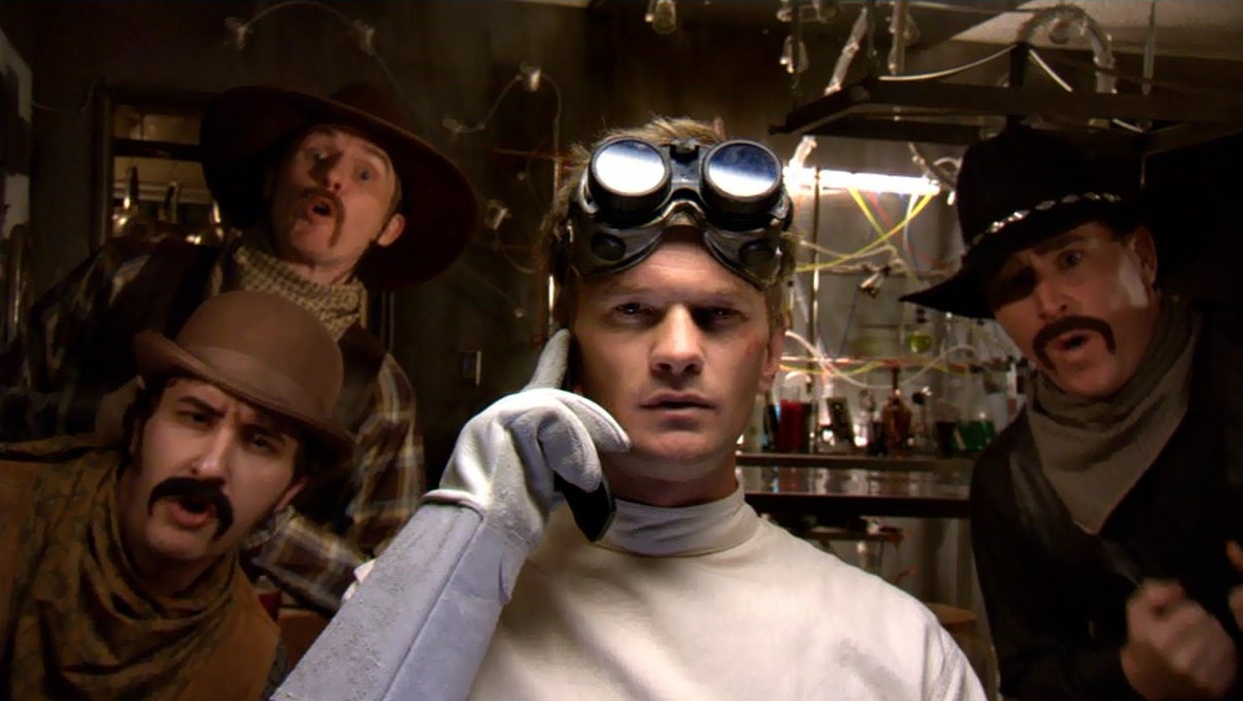
Dr. Horrible's Sing-Along Blog and Satire

Dr. Horrible's Sing-Along Blog is a 40-minute long 3-act musical miniseries published online in 2008. Despite being rather low-budget, the production boasts big names like Nathan Fillion, Joss Whedon and Neil Patrick Harris. The dramatic comedy has become a cult classic over the years. It depicts the life of Dr. Horrible, a down-to-earth, relatable, generally adorable supervillain.

Yes, that's right. The protagonist is a supervillain. Not an anti-hero, not a morally ambiguous veteran who has to make compromises for the greater good, just a straight-up bad guy. The antagonist, Dr. Horrible's nemesis, is a superhero by the name of Captain Hammer- an obnoxious, chauvinistic beefcake who only saves the day to get the glory. Dr. Horrible, to contrast, is polite and witty, and it becomes incredibly easy to root for him and his half-baked malicious schemes wholeheartedly.

In this regard, Dr. Horrible's Sing Along Blog is an excellent example of multiple forms of satire. First, there is situational irony- the villain is the hero, and the hero is the villain. This is very important since it serves as a deconstruction of tropes in American culture. American media likes to tell stories as simply as possible. According to most TV shows, there is a force for good and a force for evil, and everyone should want the former to win. In reality, questions of morality and justice are much more complicated and difficult to rationalize. If Horrible's intentions are good but his actions are evil, how does that compare to Captain Hammer, whose actions are good but intentions are selfish?


Additionally, the musical serves as a hyperbolic parody of several superhero movies. One of the frequent complaints of superhero movies is that the characters are not well-rounded. For example, the hero is often portrayed as brave and heroic, without much else going into his personality. Captain Hammer parodies that idea by taking it to the extreme- making him completely superficial and shallow to the point where it's ridiculous. Similarly, Dr. Horrible's sidekick Moist, whose only superpower is to constantly be sweaty, seems to mock the uselessness of supporting characters in superhero movies. To quote Moist himself, "at my most badass I make people want to take a shower."


Dr. Horrible's Sing-Along Blog accomplishes all of this and at the same time manages to be extremely funny and surprisingly emotional. Its clever dialogue and interesting characters stand out as excellent examples of satire. The entire thing is in HD on Youtube and watched in under an hour, which I highly suggest you do.


Monday, November 23, 2015

Boondocks

The cartoon, Boondocks, follows an African American family and their daily lives. One character by the name of "Uncle Ruckus" is African American male who constantly bashes and degrades other African Americans. Uncle Ruckus is a dark skinned, African American male. Physically, he fits the description of an African American but, mentally, he feel that he is too sophisticated to be classified as an African American.

He feels that he is too superior to be classified as an African American. Boondocks depicts this by using situational irony. This is situational irony because he is an African American and he down talks other African Americans. He feels that African Americans do not fit the criteria to be accepted in society.

Boondocks criticizes society because it shows the possible mindset of some African Americans. Some African Americans may feel that the actions of other African Americans may separate them. Others may feel that they are too educated or superior to be classified with other African Americans. In today's society, African Americans still face many stereotypes. Some feel that they can rise above this, while others cannot.


A completely serious announcement.

Sky Williams is a YouTube star and comedian, specializing in video game humor, providing reviews, commentaries, guides and announcements within his channel, all while exercising his comedic talent. In this particular video, he speaks out on Riot Games, the developers of the worldwide phenomenon League of Legends, and their marketing/advertising decisions. Williams poses as Riot Games' CEO, talking about the changes made to the game, and why they were made.

Part of what makes this video funny and satirical is that you don't have to entirely understand how the game works to find it funny, as the points he makes apply to a lot of the decisions that CEO's make in regards of their companies. A lot of it revolves around how companies don't truly care about their community and how happy they are, and if they don't like it, they can "fight me." Williams also touches on the fact that part of what Riot Games is doing by releasing a set of "chroma packs," which are just the recoloring of in-game models. "We're releasing chroma packs just to distract you from the things that have a negative effect on the game," the video at this point cuts to pictures of sad children.


Sunday, November 22, 2015

Hell not Large Enough for Society's Ills: Examples of Satire in The Onion

The Onion, "America's finest news source," is a a media and news company based in Chicago that mocks conventional media and news sources. The website itself mimics that of a traditional news source. For example there are various headings for topics on sport, business, politics, entertainment, etc. There is even a division of the news source called "After Birth" that calls itself a "definitive guide to parenting, providing every answer you need from the greatest moment in your life to the ensuing 18 worst years of your life." The Onion also has videos, political cartoons, and a section where voices of the American public make insightful comments.

Satire can be found throughout almost every facet in the Onion; in its articles, videos, reviews, etc. One example of one of many satirical articles is, "Tenth Circle Added to Rapidly Growing Hell."
This article makes fun of American corporate and business high level workers. The article describes Hell, and its previous nine layers adapted from Dante's Inferno, as a real entity, similar to a country with a government. The proposed plan of Hell is to create a new level to help contain the exponential growth of those damned to this inferno.


The article employs a lot of hyperbole and parody. Hyperbole is used when describing the outlandish punishments that "demographers, advertising executives, and tobacco lobbyists," have to endure. For example, as one Disney lawyer said, "I'm being boiled upside down in lard while jackals gnaw at the soles of my feet. If I could just reach the fax machine on the nearby rock, I could contact some well placed associates and work something out, but it's just out of my grasp, and it's out of ink and constantly blinking the message, 'replace toner cartridge, replace toner cartridge...'"

The overall parody of the article also adds to its satirical effect. The idea of Hell being portrayed as an actual country with leaders, in this case Satan, and political parties, such as the Hell purists, makes fun of American government, in addition to making fun of corporate society. Overall, the article brings to light the corruption of the corporate sector, with workers who deserve to be in the lowest pits of Hell. The article ends with a bit of irony with a quote from Grogar Malefic (a captain from Hell's elite Demon Corps), saying that, "Hell's future looks bright," and that "'We're are really on the grow down here, this is an exciting time to be in Hell." While based on a conventional definition, Hell cannot be 'bright' nor grow upwards, but this irony adds to the overall parody that the article attempts to bring across.

Monday, November 9, 2015

Disney Channels Perpetuating Stereotypes

Stereotypes of race on television shows can have a large negative impact, especially when little kids are watching these shows. In multiple Disney Channel shows, there are Indian characters that are placed with almost every Indian stereotype imaginable. Because so many young children are watching these television shows, the stereotypes are perpetuated and ingrained even more into society. For the many children who watch Disney Channel, this is now the idea of Indian people that possess.
    One show in particular, “Jessie”, shows an adopted boy named Ravi. Ravi is constantly referencing tigers, fortune telling, curry, samosa, or ganesh. He also teaches a yoga class, and is often bribed in one way or another to do his brothers homework for him because he is “good at math and science.”
Ravi is seen at the 54 second mark being made fun of for his traditional Indian outfit.

    It is not only the show “Jessie” that prolongs these stereotypes. In the Disney Channel hit show, “Phineas and Ferb,” Baljeet plays the role of the little Indian boy who helps Phineas and Ferb calculate the math in their constructions. Emerging series such as “Bunk’d,” also continue to perpetuate these stereotypes.
    Most children who watch these shows already have a set ideal about how Indian people dress, think, and act. Disney may be trying to teach children about culture, however they end up perpetuating false stereotypes.
     The extent of racist stereotypes used on Disney could almost be confused for being satirizing. Children are vulnerable to believing what they see in the media, and it is hazardous for Disney Channel to be perpetuating these stereotypes.

Fresh Off the Stereotypical Boat

Fresh Off the Boat is a recent ABC sitcom, first airing early this year, that revolves around an Asian-American family living in Orlando, Florida. The show is adapted from the famous chef, Eddie Huang’s memoir of his life, mainly taking place in the 90’s. As the derogative name suggests, the parents migrated from their native Taiwan to Washington DC who then move to Florida so the father could pursue his dream of owning a restaurant. Their transition from DC Chinatown to a middle-class white suburb isolates the family from their uncultured neighbors. Although Fresh Off the Boat aims to break and hinder stereotypes, the execution falls short in that the characters are isolated from everyone else and have stereotypes that are overly exaggerated for comedic factor.


The main intent of the Fresh Off the Boat storyline aims to shatter Asian stereotypes. For example, the main character is Eddie, the oldest child who is a school rebel with an obsession for hip hop rather than a studious and determined student. And rather the father owning an Asian restaurant, his dream restaurant is a steakhouse. Though they begin to assimilate with their neighbors, they also try to keep their culture. The objective is to portray the Huangs as just another American family chasing the American Dream with a small twist. The producers wish the audience to relate to the Huangs and have a better perception of Asian Americans as a whole.


However, while breaking some stereotypes, others are accentuated and over exaggerated. For instance, the mother, Jessica, is a stereotypical “Tiger Mom”, one who controlling and strict over her kids with an extreme emphasis for her kids to over achieve in school. In season one's episode two, "Home Sweet Home-School", all children receive high marks on their report cards, leaving Jessica the impression their school is too easy. When asking for each child to be placed in gifted programs, she is left astounded to find there isn't any. So she takes matters into her own hands and decides to send them to CLC, Chinese Learning Center. Every day after school, the kids have lesson plans to do additional hours of lessons and tests. The children are shown to have lost all their freedoms, bound to school 24/7. At one point, Eddie looks out of the window to see some neighbor kids playing with a stick and he remarks, "Look at them, the innocence. I couldn't hear them through the reinforced glass, but I imagined it was the sound of childhood. Enjoy your stick, white friends". This promotes the false idea that Asian mothers are so obsessed with their children succeeding in school, that they are willing to deprive them of any freedom of their childhood they have.

Not to mention, the stereotype that Asians are exceptionally stingy is also strongly promoted by the mother. Even though the family became friends with their neighbors, coworkers, or classmates, the Huangs remain to be in the limelight due to their ethnicity and origin. In addition, offensive jokes and misunderstandings of Asian culture are used as a comic effect in the show. The title itself is a derogative term given to immigrants (particularly from Asia) implying they are "fresh" to the country and have not yet assimilated to American culture.

These stereotypes and presumptions about Asians and the culture extend beyond just this show. For example, hardly ever do Asian actors play nondescript roles, so the Asian roles they play are heavily stereotyped. The media’s portrayal of Asians affects the audience’s perceptions allowing them to believe the misconceptions fed to them are the truth.